
Alhambra Palace Night Tour Attendance Revenue: Attendance, Ticket Prices, Revenue Estimates, and the Economics of Night Visits
The Alhambra Palace in Granada, Spain, is one of the world’s most famous historic attractions. Millions of people visit the Alhambra and Generalife complex each year, creating a large cultural and economic footprint for Granada and Andalusia.
But there is a more specific question that is much harder to answer: how many people attend the Alhambra Palace night tour, and how much revenue does that night-tour activity generate?
This is where careful research becomes important.
The phrase “alhambra palace night tour attendance revenue” can make it sound as if there is one official annual number covering both night-tour attendance and night-tour income. In reality, the public information is more detailed in some areas than others. The Patronato de la Alhambra y Generalife publishes overall visitor information, official ticket prices, schedules, and financial information. However, a current annual figure specifically separating the number of night-tour visitors and the revenue generated only by those visitors is not clearly published in the sources reviewed for this article.
The distinction matters.
The Alhambra received approximately 2.72 million visitors in 2024, according to the Government of Andalusia. But that figure represents the monument as a whole. It should not be treated as the number of people attending the night tour.
The Patronato’s visitor studies have historically reported the share of visitors using different visit types. One published study, for example, recorded night visits at 2.68 percent, compared with 87.71 percent for daytime visits. However, that particular data set is historical and should not be presented as a current 2026 night-tour share.
This article therefore takes a more useful approach. It examines what is officially known, explains how night-tour attendance works, looks at current official ticket prices, estimates possible revenue under clearly stated assumptions, and explains why the economics of the Alhambra cannot be understood by multiplying total visitors by a ticket price.
The goal is to provide a practical and evidence-based guide for readers interested in Alhambra attendance, night tours, tourism economics, ticket revenue, and the financial role of cultural heritage.
What Is the Alhambra Palace Night Tour?
The Alhambra night tour is not simply the normal daytime visit moved to the evening.
The official Patronato offers specific nighttime experiences, including a night visit to the Nasrid Palaces and a separate night visit to the Gardens and Generalife.
The Nasrid Palaces night visit includes important areas such as:
- Mexuar
- Palace of Comares
- Palace of the Lions
- Corredor-Lindaraja
- Carlos V Palace
- Gate of Justice
The official description emphasizes the special atmosphere of the Nasrid Palaces after dark. The nighttime experience also has rules designed to protect the quality of the visit, including restrictions on camera flashes.
The Gardens and Generalife night experience is a different product. It includes areas such as the Generalife Gardens and Generalife Palace.
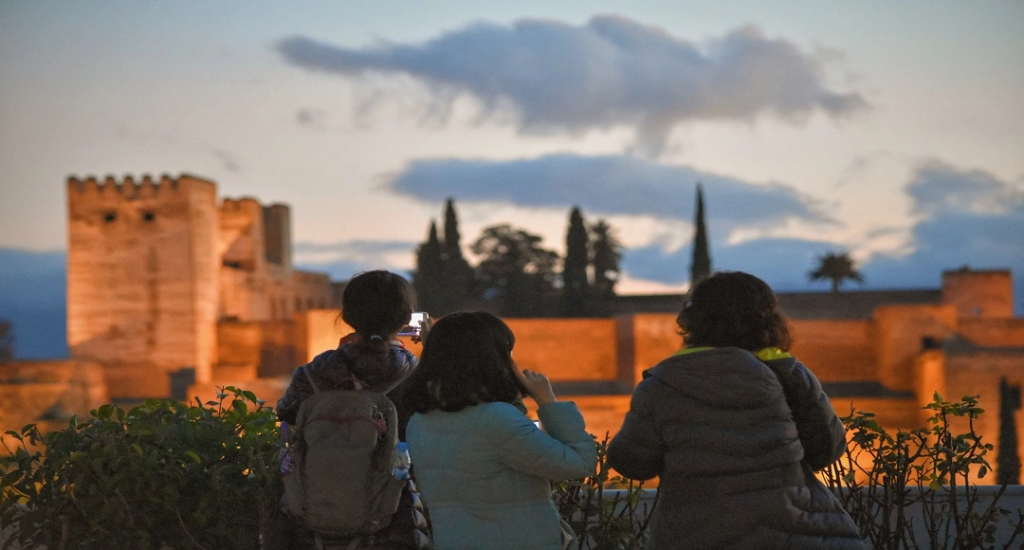
This distinction is essential when calculating attendance and revenue.
Also read:Antarvafna: The Ancient Indian Practice of Hearing Your Inner Self
Someone buying a Nasrid Palaces night ticket should not automatically be counted as someone buying a Generalife night ticket. They are separate products, with separate schedules and pricing.
How Many People Visit the Alhambra Each Year?
The latest broad figure available from the Government of Andalusia is especially useful.
In 2024, the Alhambra was again the most visited cultural site managed by the regional government, receiving approximately 2.72 million visitors. The broader group of cultural spaces managed by the Junta de Andalucía received nearly 7.95 million visits that year.
This makes the Alhambra one of Spain’s most important cultural tourism destinations.
However, the 2.72 million figure should be interpreted correctly.
It is not:
- 2.72 million night-tour visitors
- 2.72 million paid tickets for Nasrid Palace night visits
- 2.72 million individual people necessarily making only one visit
- 2.72 million tickets sold at one identical price
It is a broad visitor figure for the Alhambra.
This distinction is one of the most important points in understanding Alhambra Palace night tour attendance revenue.
Why Total Alhambra Attendance Does Not Equal Night Attendance
A visitor can experience the Alhambra in different ways.
The official ticket system includes products such as:
- General Alhambra visit
- Gardens, Generalife and Alcazaba
- Night Visit to Nasrid Palaces
- Night Visit to Gardens and Generalife
- Dobla de Oro
- Dobla de Oro at Night
- Alhambra Experiences
- Other combined experiences
The official ticket website currently lists the standard Night Visit to Nasrid Palaces at €12.73 and the Night Visit to Gardens and Generalife at €8.48.
This means that a simple calculation such as:
2.72 million visitors × €12.73
would produce a number that looks like revenue, but it would be misleading.
Why?
Because most visitors do not buy the night-only Nasrid Palace ticket.
Different visitors purchase different ticket types.
Some may visit during the day.
Some may visit the gardens.
Some may use combination tickets.
Some may have reduced-price admission.
Some may be part of educational or cultural programs.
Therefore, overall attendance must be separated from night-tour ticket sales before meaningful revenue calculations can be made.
Current Alhambra Night Tour Ticket Prices
The official ticket website currently lists the Night Visit to Nasrid Palaces at €12.73.
The official website also lists the Night Visit to Gardens and Generalife at €8.48.
There is also a combined Dobla de Oro at Night ticket priced at €23.06 on the current official ticket platform. This product includes the nighttime Nasrid Palaces visit plus access to several Andalusian monuments.
Another product, Alhambra Experiences, is currently listed at €22.27 and combines a nighttime Nasrid Palaces visit with a daytime visit to parts of the complex on the following day.
These prices demonstrate why calculating “night-tour revenue” is complicated.
Not every person entering the Nasrid Palaces at night necessarily generates exactly the same amount of ticket revenue for the night component.
Why Ticket Revenue and Economic Impact Are Different
There is another important distinction between revenue and economic impact.
Ticket revenue is money associated with admission and related services.
Economic impact is much broader.
Visitors can spend money on:
- Hotels
- Restaurants
- Transportation
- Shops
- Tour operators
- Museums
- Local attractions
- Entertainment
A historical Alhambra-related announcement from the Patronato and Andalusian authorities reported an economic impact on Granada of around €500 million per year from visitors to the Alhambra and Generalife, along with direct and indirect employment effects. That figure is much broader than Alhambra ticket income and should not be confused with ticket revenue.
This is an important distinction for anyone researching the keyword “alhambra palace night tour attendance revenue.”
A €1 earned from an entrance ticket is not the same as €1 spent by a tourist throughout Granada.
Is There an Official Current Night-Tour Attendance Number?
The available official sources provide overall visitor information and historical breakdowns by visit type, but they do not clearly present a current annual figure specifically labeled as “Night Visit to Nasrid Palaces attendance” for the latest full year.
The Patronato does maintain visitor studies.
Its visitor-analysis program examines visitor demand, seasonal behavior, access control, and visitor flows. The organization explains that it uses quantitative visitor counts, surveys, and controls at the Nasrid Palace entrance to monitor saturation and visitor flows.
This is valuable because it shows that the institution tracks visitor behavior in detail.
But tracking information internally does not necessarily mean every category is publicly released as an annual revenue statistic.
Therefore, any website claiming an exact current night-tour attendance number should be checked carefully for its underlying source.
Historical Evidence About Night Attendance
One official visitor study provides an interesting historical reference.
The Patronato reported that daytime visits represented 87.71 percent of visits in the study, Gardens visits represented 8.09 percent, night visits 2.68 percent, and tourist vouchers 1.18 percent.
This historical figure is useful for understanding the relative size of the nighttime product.
But it should not be used as if it were a 2024, 2025, or 2026 measurement.
Tourism behavior changes over time.
Ticket prices change.
Opening schedules change.
Visitor capacity changes.
Product design changes.
Travel patterns change.
Therefore, using an old 2.68 percent figure to calculate modern revenue would produce only a historical-style scenario, not an official current estimate.
A Simple Illustrative Attendance Calculation
Even though current night-only attendance is not clearly published in the reviewed sources, we can demonstrate how the economics work.
Suppose, purely for illustration, that 2.68 percent of 2.72 million annual visits were night visits.
The calculation would be:
2,720,000 × 0.0268 = 72,896 visits
That would produce approximately 72,900 night visits.
But this is an illustrative calculation, not an official 2024 attendance figure.
It uses a historical share against a current overall visitor number.
That distinction must be kept clear.
What Would 72,900 Night Visits Mean for Revenue?
If all 72,896 hypothetical visitors purchased the current €12.73 Nasrid Palaces night ticket, the theoretical gross ticket value would be approximately:
72,896 × €12.73 = €928,000
Rounded, that is about €0.93 million.
Again, this is not reported Alhambra night-tour revenue.
It is a mathematical scenario based on:
- 2.72 million total annual visitors
- 2.68 percent historical night-visit share
- Current €12.73 standard Nasrid Palaces night-ticket price
Because those inputs do not belong to the same reporting period, the result should be treated only as an analytical example.
Why This Estimate Could Be Too High or Too Low
There are several reasons.
First, the historical 2.68 percent share may no longer represent current visitor behavior.
Second, not every night visitor necessarily pays the full standard price.
Third, some visitors use combined products.
Fourth, some categories may have different prices.
Fifth, ticket prices have changed over time.
Sixth, attendance may be constrained by capacity.
Seventh, some visitors may be included in broader visitor statistics differently from ticket-sale statistics.
Therefore, the calculation is useful for understanding the scale, but it should never be described as audited revenue.
The Importance of Visitor Capacity
The Alhambra cannot simply increase attendance without limits.
It is a fragile historic site.
The Patronato’s visitor studies specifically discuss controlling access and managing visitor flows, with particular attention to the Nasrid Palaces because of their sensitivity and saturation risks.
This creates an interesting economic situation.
For many businesses, more customers are almost always better.
For a historic monument, unlimited visitors could damage the very asset that attracts visitors.
Therefore, the optimal strategy is not necessarily maximum attendance.
It is controlled attendance.
Why Night Tours Can Have Strategic Value
Night tours provide several benefits beyond ticket sales.
They can:
- Extend the visitor experience beyond daytime hours
- Spread visitor demand across time
- Create a different atmosphere
- Provide additional cultural programming
- Generate supplementary ticket income
- Reduce pressure on certain daytime periods
This makes night tourism an important part of managing a high-demand cultural attraction.
The Alhambra’s night schedule changes by season, reflecting daylight hours and visitor conditions. For example, the official Nasrid Palaces schedule currently operates Friday and Saturday evenings from October 15 through March 31 and Tuesday through Saturday from April 1 through October 14.
This seasonal design also affects potential revenue.
Seasonality and Alhambra Night Tour Attendance
Tourism in Granada is seasonal.
Night-tour demand can depend on:
- Weather
- Sunset time
- Holiday periods
- School vacations
- International travel
- Hotel occupancy
- Local events
Summer evenings can be attractive because visitors may prefer cultural activities after the hottest part of the day.
Winter schedules are shorter and operate on fewer days.
The official timetable reflects this seasonal structure.
Therefore, annual attendance should not be estimated simply by multiplying one night’s attendance by 365.
How Night-Tour Capacity Affects Revenue
Imagine a hypothetical night session with 300 available spaces.
If the session sells out:
300 × €12.73 = €3,819
If there are two sessions on a hypothetical day:
600 × €12.73 = €7,638
If this pattern occurred repeatedly, the revenue could become substantial.
But the actual number of available places, operating days, product mix, and occupancy rates must be verified from official records before calculating annual revenue.
This is why a capacity-based model can be more useful than guessing from total annual visitors.
The Role of the Nasrid Palaces
The Nasrid Palaces are central to the Alhambra’s night-tour product.
The official description identifies the Mexuar, Comares, and Palace of the Lions among the main areas connected to the visit.
These spaces are particularly important because they contain some of the most famous decorative and architectural features associated with the Alhambra.
The nighttime experience changes how visitors perceive:
- Light
- Shadows
- Courtyards
- Decorative surfaces
- Water
- Architecture
- Spatial transitions
This makes the night visit a distinct cultural product rather than merely an alternative opening time.
Night Visit to the Generalife
The Generalife is also offered as a separate nighttime experience.
The official ticket currently lists the Night Visit to Gardens and Generalife at €8.48.
The experience includes the access pavilion, Generalife Walnut Trees’ Walk, Generalife Gardens, and Generalife Palace.
This means that any comprehensive analysis of Alhambra night-tour attendance should consider both:
- Nasrid Palaces night visits
- Generalife night visits
Treating only the Nasrid Palace ticket as the entire night-tour market can underestimate the overall nighttime visitor economy.
Combined Night Products
The Alhambra also sells combined nighttime products.
The Dobla de Oro at Night ticket is currently listed at €23.06. It includes the Nasrid Palaces night visit and several Andalusian monuments, including the Bañuelo, Corral del Carbón, Casa Morisca, Palacio de Dar al-Horra, Casa del Chapiz, and Casa de Zafra.
This is important from a revenue-analysis perspective.
A combined ticket can generate more total ticket revenue than a single attraction ticket, but the entire €23.06 should not automatically be assigned to the Nasrid Palaces night tour.
Part of the value relates to other monuments.
Therefore, accounting should distinguish between:
- Ticket sales
- Product revenue
- Revenue attributable to individual attractions
Alhambra Experiences and Revenue Allocation
The Alhambra Experiences product is another example.
The current official ticket price is €22.27. It combines a night visit to the Nasrid Palaces with a daytime visit to the Partal, Alcazaba, and Generalife areas on the following day.
If one visitor purchases this ticket, the entire €22.27 represents revenue from the combined product.
It would be incorrect to say that the night tour generated €22.27 by itself.
A proper accounting system would allocate the revenue according to the organization’s accounting rules or product structure.
What Does the Alhambra’s Overall Revenue Look Like?
The official 2024 Andalusian budget provides useful context.
Also read:Smoothiepussit: A Complete Guide to Smoothie Pouches, Benefits, Uses, Nutrition, and Smart Choices
The Patronato de la Alhambra y Generalife had a total 2024 income budget of €39,662,565. Of this, €38,014,065 was budgeted under public prices for visits and cultural activities at the Alhambra and Generalife monumental complex.
That is a very important figure.
It shows the financial scale of the institution.
But once again, €38.014 million is not night-tour revenue.
It represents public-price income associated with visits and cultural activities at the complex.
The 2024 Budget Shows How Important Ticket Income Is
The 2024 budget documentation explains that the Patronato’s budget is supported primarily by its own income, especially income from ticket sales to the monumental complex, along with administrative concessions and other sources.
This means visitor revenue plays a central role in the financial model of the institution.
The 2024 budget also included €1,621,500 in patrimonial income, including concessions, special uses, administrative contracts, vending-machine exploitation, and rental income.
The structure can therefore be simplified as:
Visitor-related income = major source
Other income = supplementary source
Public funding and other financing mechanisms = additional support where applicable
This structure helps explain why visitor management and ticket pricing matter so much.
Revenue Is Not the Same as Profit
A common mistake is to see millions of euros in ticket revenue and assume that the Alhambra earns the same amount as profit.
That is incorrect.
A historic monument requires substantial spending on:
- Conservation
- Restoration
- Security
- Staff
- Cleaning
- Landscaping
- Technology
- Ticketing
- Visitor management
- Utilities
- Research
- Cultural programs
- Infrastructure
- Accessibility
The purpose of the Patronato is not simply to maximize financial profit.
Its responsibilities include preserving the monument and managing public access.
The official organizational description states that the Patronato’s functions include conservation, restoration, investments, general plans, and oversight of the monumental complex.
Why Conservation Changes the Revenue Equation
Suppose the Alhambra could double night attendance.
That might increase ticket income.
But if the additional visitors created unacceptable wear on fragile historic surfaces, the long-term cost could be much greater.
The correct economic question is therefore not:
“How can the Alhambra sell the maximum number of tickets?”
It is:
“How can the Alhambra generate sustainable visitor income while protecting the monument?”
That is a very different objective.
The Economics of Controlled Tourism
The Alhambra is an excellent example of controlled tourism.
Demand is extremely high.
But supply is limited.
The monument cannot simply build more historic rooms.
It cannot double the size of the Nasrid Palaces.
It cannot move fragile architecture to a larger building.
Therefore, visitor capacity becomes a management tool.
Limited capacity can also increase the perceived value of the experience.
Visitors may consider a night visit more special because it is available only at certain times and in controlled numbers.
How Pricing Can Influence Night Attendance
Ticket pricing can affect demand.
A lower price may attract more visitors.
A higher price may generate more revenue per visitor but reduce attendance.
The ideal price depends on several factors:
- Visitor demand
- Capacity
- Season
- Operating cost
- Conservation requirements
- Product quality
- Alternative attractions
The current official Nasrid Palaces night ticket price of €12.73 provides one data point for understanding the current market.
The Generalife night ticket at €8.48 provides another.
Also read:Smoothiepussit: A Complete Guide to Smoothie Pouches, Benefits, Uses, Nutrition, and Smart Choices
Historical Price Changes Matter
The official Andalusian price order published in 2025 provides another useful piece of evidence.
It lists reduced prices of €8 for the Nasrid Palaces night visit and €6 for the Generalife night visit.
This demonstrates that different price categories can exist.
Therefore, even if night attendance were known, multiplying every visitor by the headline ticket price could still overstate actual ticket revenue.
Why Revenue Estimates Need a Price Mix
A more realistic formula is:
Night-tour revenue = number of visitors × average realized ticket price
The important phrase is average realized ticket price.
The average may differ from the headline price because of:
- Reduced-price admissions
- Combined tickets
- Special programs
- Tourist passes
- Promotional structures
- Other categories
Therefore, the average realized price can be lower than the standard advertised price.
A Better Formula for Estimating Night Revenue
A more detailed model would be:
Night revenue =
Nasrid night tickets × average Nasrid ticket revenue
Generalife night tickets × average Generalife ticket revenue
Allocated share of combined-ticket revenue
Allocated share of other nighttime products
This is much more accurate than using total Alhambra attendance.
A Hypothetical Revenue Model
Consider a purely hypothetical scenario.
Suppose a year contained:
50,000 Nasrid Palace night visitors
20,000 Generalife night visitors
10,000 visitors through combined nighttime products
If we assumed, only for illustration, an average realized revenue of €12 per Nasrid visitor and €8 per Generalife visitor, the basic revenue would be:
50,000 × €12 = €600,000
20,000 × €8 = €160,000
The combined-ticket category would require an allocation method.
This would produce at least €760,000 before accounting for the allocated combined-ticket revenue.
The figures are examples, not official attendance or revenue.
The purpose is to show how a professional analysis should be constructed.
Why Search Results Often Get the Number Wrong
The keyword “alhambra palace night tour attendance revenue” combines several concepts that are frequently mixed together online.
These concepts include:
- Overall Alhambra attendance
- Night-tour attendance
- Ticket prices
- Ticket revenue
- Granada’s tourism impact
- Alhambra’s total budget
- Hotel and restaurant spending
They are related but not identical.
A page may say the Alhambra gets 2.7 million visitors and then calculate night revenue by applying a night-tour ticket price to all 2.7 million people.
That is not a valid calculation.
The Difference Between Visitors and Visits
Another important issue is the difference between visitors and visits.
A person can potentially visit a monument more than once.
A visitor count may represent people, while an attendance figure may represent entries or visits.
This distinction becomes even more important when combined tickets allow access across multiple days.
The official ticket system itself shows products that spread experiences over consecutive days. For example, Alhambra Experiences combines a night visit with a daytime visit on the following day.
Therefore, counting every entry as a completely separate tourist can produce misleading results.
How Night Tours Affect Granada’s Tourism Economy
Night visits can create economic benefits beyond the monument.
A tourist who attends an evening Alhambra tour may:
- Stay overnight in Granada
- Eat dinner before or after the tour
- Use taxis or public transportation
- Purchase local products
- Visit other attractions
- Extend the length of the trip
This creates a multiplier effect.
However, not all spending should be attributed directly to the night tour.
A visitor may have already planned to stay in Granada regardless of the Alhambra experience.
Therefore, economists distinguish between direct, indirect, and induced economic effects.
The Alhambra’s Wider Economic Importance
Historical official information gives an indication of the monument’s wider role.
The Patronato and Andalusian tourism authorities previously reported that Alhambra and Generalife visitors generated an economic impact of around €500 million annually in Granada and supported approximately 6,800 direct and indirect jobs.
This figure is historical rather than a current 2026 measurement, but it demonstrates the scale of the monument’s importance to the local economy.
The key point is that the value of the Alhambra is much larger than ticket revenue alone.
Night Tours and Hotel Demand
Night tours can have an especially interesting relationship with hotel demand.
A visitor arriving for a daytime attraction may leave Granada afterward.
A visitor attending a late evening attraction may be more likely to stay overnight, depending on travel plans and transportation.
This can potentially increase:
- Hotel occupancy
- Restaurant spending
- Local transportation use
- Evening retail activity
But this effect must be measured through tourism data rather than assumed.
Why the US Audience May Care About This Topic
For American travelers planning a trip to Spain, the economics of the Alhambra may seem distant from practical travel decisions.
But understanding the attendance and revenue structure explains why tickets can be limited.
The Alhambra is a fragile heritage site with very high demand.
Limited availability is not simply a marketing technique.
It is also connected to visitor management and conservation.
The official FAQ confirms that tickets are personal and non-transferable and that visitors must present identification with their tickets.
This level of control reflects the site’s popularity and management requirements.
Why Booking Early Matters
Night tours have specific operating schedules.
The official Nasrid Palaces night visit currently operates from 8:00 to 9:30 p.m. on Fridays and Saturdays from October 15 to March 31, and from 10:00 to 11:30 p.m. Tuesday through Saturday from April 1 to October 14.
These limited schedules mean that travelers cannot assume a night tour is available every evening.
Availability can also depend on the date and ticket type.
For travelers, checking the official ticket calendar is therefore more reliable than relying on old travel articles.
The Role of Official Data in Revenue Research
For a topic such as Alhambra Palace night tour attendance revenue, source quality is extremely important.
The best sources are:
- Patronato de la Alhambra y Generalife
- Junta de Andalucía
- Official ticketing platform
- Official budget documents
- Official visitor studies
- Public financial accounts
The Patronato’s transparency portal publishes economic and budgetary information, including historical budgets and available annual accounts.
The Junta de Andalucía also publishes the General Account, including information related to the Patronato.
These are more reliable for financial analysis than travel blogs or unsourced websites.
What the 2024 Budget Tells Us
The 2024 budget provides one of the clearest financial reference points.
The Patronato budgeted €39.662565 million in total income.
Of this amount:
€38.014065 million came from public prices associated with visits and cultural activities at the Alhambra and Generalife complex.
The remaining current-income categories included other public prices, sales of goods and services, concessions, special uses, administrative contracts, vending operations, and property rentals.
This gives readers a useful scale.
The Alhambra’s visitor-related financial activity is measured in tens of millions of euros annually.
But night tours represent only one component of that total.
Could Night Tours Generate Millions of Euros?
Potentially, yes, depending on attendance and ticket mix.
But the publicly available information reviewed here does not support claiming a specific current annual night-tour revenue figure.
For example, if a night product attracted 100,000 visitors at an average realized revenue of €10 per visitor, that would generate:
€1 million.
If it attracted 200,000 visitors at €10:
€2 million.
If it attracted 50,000 visitors at €12:
€600,000.
These examples show why even relatively small percentages of the Alhambra’s total attendance can translate into meaningful revenue.
But without official attendance and realized-price data, these remain scenarios.
A More Useful Way to Think About Night Revenue
Rather than asking only:
“How much money does the Alhambra make from night tours?”
it is better to ask:
“What is the relationship between night capacity, ticket pricing, attendance, operating cost, and conservation?”
That is the real economic question.
A successful nighttime program should ideally:
- Attract sufficient demand
- Generate useful income
- Provide a high-quality experience
- Avoid damaging historic spaces
- Fit conservation requirements
- Spread tourism activity
- Support the broader cultural mission
Operating Costs of Night Tours
Night operations can have additional costs.
These may include:
- Lighting
- Security
- Staff
- Cleaning
- Maintenance
- Visitor management
- Electricity
- Technology
- Transportation coordination
- Conservation monitoring
Therefore, gross ticket revenue is not the same as net financial contribution.
If a nighttime program generates €1 million in ticket revenue but costs €300,000 to operate, its financial contribution is different from a program costing €900,000.
Public institutions must consider both revenue and costs.
Lighting and Conservation
Night lighting is particularly important at a historic site.
Lighting can improve the visitor experience, but it must be carefully managed.
Too much light can affect:
- Historic materials
- Wildlife
- Energy consumption
- Visitor perception
- The visual character of the monument
This makes nighttime programming an engineering and conservation challenge as well as a tourism product.
The Future of Alhambra Night Tours
The future may involve more sophisticated visitor management.
Possible developments could include:
- Dynamic visitor-flow monitoring
- Better reservation systems
- Digital visitor information
- More detailed attendance reporting
- Energy-efficient lighting
- Improved accessibility
- Data-driven scheduling
The goal should not simply be more people.
The goal should be a better visitor experience with sustainable management.
Could Night Attendance Increase?
There may be opportunities to increase night attendance during periods when capacity and conservation allow it.
For example, management could examine:
- Seasonal demand
- Unused evening capacity
- Visitor satisfaction
- Local hotel demand
- Transportation availability
- Energy costs
If additional sessions can be added without increasing conservation risks, night tourism could become an even more important part of the visitor economy.
But the site’s physical limits remain the primary consideration.
Why the 2.7 Million Figure Needs Context
The widely quoted figure of roughly 2.7 million visitors is useful because it demonstrates the Alhambra’s popularity.
Also read:MCAT Score Calculator: How to Calculate Your MCAT Score and Understand Your Results
The 2024 official figure of approximately 2.72 million is stronger because it comes from the Government of Andalusia.
However, this number should never be directly converted into night-tour revenue.
The correct analytical chain is:
Overall visitors
→ type of visit
→ night-tour attendance
→ ticket category
→ average realized ticket price
→ gross ticket revenue
→ operating costs
→ net financial contribution
Each step requires separate information.
A Summary of the Most Reliable Numbers
Here are the most useful current figures discussed in this article:
| Metric | Figure | Meaning |
| Alhambra visitors in 2024 | About 2.72 million | Overall visitor figure |
| 2024 Patronato income budget | €39.662565 million | Total budgeted income |
| 2024 visit/cultural activity public-price income | €38.014065 million | Major visitor-related income category |
| Current Nasrid Palaces night ticket | €12.73 | Standard listed price |
| Current Generalife night ticket | €8.48 | Standard listed price |
| Current Dobla de Oro at Night | €23.06 | Combined night product |
| Current Alhambra Experiences | €22.27 | Night + daytime combined product |
| Historical night-visit share in published study | 2.68% | Historical, not a current 2026 rate |
The sources for these figures are the official Patronato, Junta de Andalucía, and official ticketing pages.
What We Can Say With Confidence
Several conclusions are well supported.
First, the Alhambra is an extremely high-volume cultural attraction, with about 2.72 million visitors in 2024.
Second, night visits are a smaller specialized part of the overall visitor program rather than the majority of attendance. Historical official visitor data supports this general interpretation, although the exact historical percentage should not be applied to current years without qualification.
Third, the current official Nasrid Palaces night ticket is €12.73, while the Generalife night ticket is €8.48.
Fourth, visitor-related income is central to the Patronato’s finances. The 2024 budget allocated €38.014065 million to public prices associated with visits and cultural activities.
Fifth, there is no sound basis for claiming that the entire Alhambra’s annual visitor revenue comes from night tours.
What We Cannot Reliably Claim
A responsible article should also explain what is not known.
The reviewed official sources do not provide a clearly labeled current annual figure for:
- Total Nasrid Palace night-tour attendance
- Total Generalife night-tour attendance
- Total night-tour ticket revenue
- Net profit from night tours
- Average revenue per nighttime visitor
Without those numbers, any exact annual night-tour revenue claim would require estimation.
That does not make estimation useless.
It simply means estimates must be labeled as estimates.
A Responsible Estimate for Researchers
Researchers can create a model using three variables:
Night attendance
Average ticket revenue
Product allocation
For example:
Annual night attendance × average realized ticket revenue = estimated night-ticket revenue
Then:
Estimated night-ticket revenue − nighttime operating costs = estimated net contribution
This model can be improved if official attendance data becomes available.
How Future Official Data Could Improve the Picture
The Patronato already has sophisticated visitor-analysis capabilities.
Its visitor study describes annual analysis of visitor profiles, seasonal changes, visitor counts, surveys, and access controls.
If future public reports provide:
- Night attendance by month
- Night attendance by product
- Average ticket price
- Combined-ticket allocation
- Operating cost
then researchers could calculate a much more accurate annual revenue figure.
This would also help tourism planners understand the value of nighttime cultural tourism.
Why the Topic Matters
The question of Alhambra Palace night tour attendance revenue is more than a search for one number.
It connects several important issues:
- Heritage conservation
- Tourism management
- Cultural economics
- Ticket pricing
- Visitor capacity
- Local employment
- Granada’s tourism industry
- Public-sector financial management
The Alhambra is valuable because it combines all of these areas in one location.
Conclusion
The most accurate answer to the question of Alhambra Palace night tour attendance revenue is that the Alhambra has a very large overall visitor base, but a precise current annual figure for night-tour attendance and night-only revenue is not clearly disclosed in the public sources reviewed.
The Alhambra welcomed about 2.72 million visitors in 2024, making it the most visited cultural site managed by the Junta de Andalucía. Historical Patronato data shows that night visits represented a much smaller share of overall visits than daytime visits, although that historical 2.68 percent figure should not be treated as a current 2026 statistic.
Current official ticket information shows that the Night Visit to the Nasrid Palaces is listed at €12.73, while the Night Visit to the Gardens and Generalife is listed at €8.48. Other combined products, such as Dobla de Oro at Night and Alhambra Experiences, have different prices and include multiple attractions or visits.
The financial importance of visitor activity is clear from the Patronato’s 2024 budget. Total budgeted income was €39.662565 million, including €38.014065 million in public-price income associated with visits and cultural activities at the Alhambra and Generalife complex.
However, this is total visitor-related institutional income, not night-tour revenue.
The key lesson is that a reliable night-tour revenue calculation needs specific night attendance, ticket-category, average realized-price, and cost information. Until those figures are publicly available for the relevant year, precise night-tour revenue numbers should be treated as estimates rather than official financial facts.
For travelers, the data also explains why Alhambra night tours can be limited and why advance planning matters. The monument is not an ordinary tourist attraction where capacity can be increased without consequences. It is a fragile historic site where visitor numbers must be balanced against conservation, safety, and the quality of the experience.
In that sense, the economics of the Alhambra are not simply about selling more tickets. They are about creating sustainable cultural tourism that helps support the preservation of one of Spain’s most important historic monuments.
Frequently Asked Questions
How many people visit the Alhambra each year?
The Alhambra received approximately 2.72 million visitors in 2024, according to the Government of Andalusia. This figure refers to the Alhambra as a whole and should not be confused with night-tour attendance.
How much is the Alhambra Palace night tour?
The official ticket website currently lists the Night Visit to the Nasrid Palaces at €12.73. The separate Night Visit to the Gardens and Generalife is listed at €8.48. Prices can vary by ticket type and eligibility category.
What percentage of Alhambra visitors attend at night?
A historical Patronato visitor study reported night visits at 2.68 percent of visits in that data set. However, this is not a current 2024, 2025, or 2026 attendance percentage, so it should not be used as a current official rate.
How much revenue does the Alhambra make from tickets?
The 2024 budget for the Patronato de la Alhambra y Generalife included €38.014065 million in public-price income for visits and cultural activities at the monumental complex. This is broader than night-tour revenue and should not be interpreted as income generated only by nighttime visits.
Is there an official annual revenue figure specifically for Alhambra night tours?
The official sources reviewed provide overall visitor, ticket-price, and institutional financial information, but they do not clearly publish a current annual figure separating night-tour attendance and night-only revenue. For that reason, exact annual night-tour revenue figures found elsewhere should be checked carefully to determine whether they are official data or estimates.