MCAT Score Calculator: How to Calculate Your MCAT Score and Understand Your Results
The MCAT is one of the most important exams for students planning to apply to medical school in the United States. Because the exam is long, challenging, and scored differently from a traditional percentage-based test, many students want a simple way to understand their practice results. This is where an MCAT score calculator can be helpful.
An MCAT score calculator can help you add section scores, estimate your total score, compare practice-test results, understand score trends, and set realistic study goals. It can also help you see how improvement in one section could affect your overall score. However, students should understand that an online calculator cannot perfectly reproduce the official AAMC scoring process when it starts with only the number of questions answered correctly.
The reason is simple. The MCAT does not use one permanent raw-score conversion table. The AAMC converts the number of questions answered correctly into scaled scores, and the exact conversion can vary between test forms. This process is called equating and is designed to account for small differences in difficulty between different versions of the exam.
For that reason, the best way to use an MCAT score calculator is as a planning and study tool rather than as a replacement for an official AAMC score report. Understanding this difference can help you use your practice scores more effectively and avoid common mistakes when estimating your performance.
What Is an MCAT Score Calculator?
An MCAT score calculator is a tool that helps students calculate or estimate their MCAT results. The simplest type takes the four section scores and adds them together to produce the total MCAT score. Other calculators attempt to estimate a scaled score from the number of questions answered correctly on a practice test.
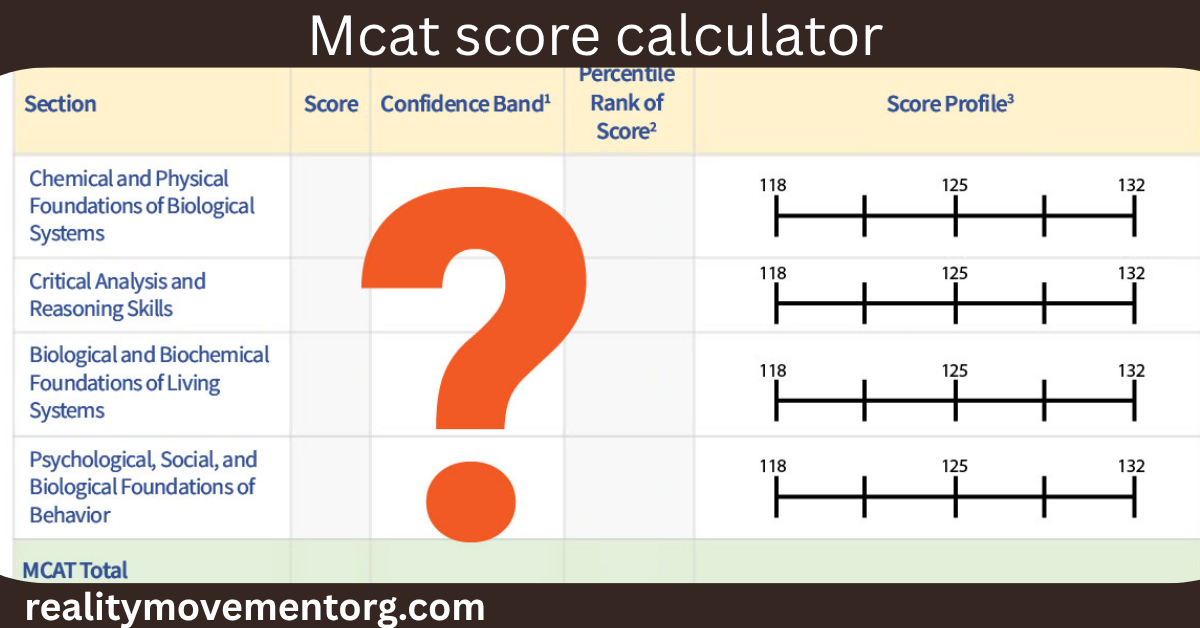
The basic total-score calculation is very simple. The MCAT has four scored sections, and each section receives a score from 118 to 132. Your total score is the sum of those four section scores. The total possible score therefore ranges from 472 to 528.

For example, imagine that a student receives a 126 on Chemical and Physical Foundations, a 128 on CARS, a 127 on Biological and Biochemical Foundations, and a 129 on Psychological, Social, and Biological Foundations. The calculation would be 126 + 128 + 127 + 129, which equals 510.
This type of calculation is exact because the section scores are already scaled scores. The more difficult part is estimating a scaled score when you only know how many questions you answered correctly.
How Is the MCAT Scored?
The MCAT contains four scored multiple-choice sections. Each section receives an individual scaled score between 118 and 132. The midpoint of each section is 125.
The four sections are Biological and Biochemical Foundations of Living Systems, Chemical and Physical Foundations of Biological Systems, Psychological, Social, and Biological Foundations of Behavior, and Critical Analysis and Reasoning Skills, commonly called CARS. The four section scores are added together to create the total MCAT score, which ranges from 472 to 528.
The AAMC first counts how many questions you answered correctly in each section. That is your raw score. The raw score is then converted into a scaled score between 118 and 132. Finally, the four scaled section scores are added together to produce your total score.
This means the MCAT is not simply a percentage test. A student cannot take a percentage such as 80 percent and directly convert it into an official MCAT score by using a simple mathematical formula.
MCAT Score Calculator Formula
If you already know your four scaled section scores, calculating your total is easy.
MCAT Total Score = C/P + CARS + B/B + P/S
For example, suppose your scores are:
C/P = 126
CARS = 127
B/B = 128
P/S = 125
Your total would be:
126 + 127 + 128 + 125 = 506
Therefore, your total MCAT score would be 506.
This is the most reliable form of an MCAT score calculator because it uses the actual scaled section scores.
What Is the MCAT Score Range?
The total MCAT score ranges from 472 to 528. Each individual section ranges from 118 to 132. The midpoint of the total scale is 500, while the midpoint of each section is 125.
The score range can sometimes be confusing for students because it does not represent the number of questions answered correctly.
A 520 does not mean that you answered 520 questions correctly.
Likewise, a 500 does not mean that you answered 500 questions correctly.
The numbers represent scaled scores.
This distinction is one of the most important things to understand when using an MCAT score calculator.
Raw MCAT Score vs. Scaled MCAT Score
A raw score is the number of questions you answered correctly. A scaled score is the score reported by the AAMC on the 118–132 scale.
For example, if you answer 40 questions correctly in one section, 40 is your raw number correct. It is not automatically your final section score.
The AAMC converts the raw number correct into a scaled score. Because different MCAT test forms contain different questions, the exact conversion is not always the same. The AAMC uses equating to account for small differences in difficulty between forms.
This is why students should be careful with online charts that claim one raw score always equals one exact MCAT scaled score.
Those charts may be useful as rough estimates for certain practice materials, but they should not be treated as universal AAMC conversion tables.
Why Does the AAMC Scale MCAT Scores?
The MCAT is offered in different forms. These forms are designed to measure the same basic concepts and skills, but they do not contain exactly the same questions.
One form may be slightly easier or more difficult than another.
The AAMC uses equating to account for these small differences. This helps ensure that a particular scaled score has the same meaning even when students take different versions of the exam.
This system is important for fairness.
Imagine that two students have similar levels of preparation. One receives a slightly easier group of questions, while the other receives a slightly harder group. If the AAMC simply used raw percentages, the second student could be disadvantaged.
Scaling and equating help reduce this problem.
Is the MCAT Graded on a Curve?
No. The MCAT is not graded on a traditional curve.
A curved exam generally means that performance is evaluated relative to the performance of other students taking the exam. The MCAT works differently. The AAMC scales and equates the exam so that scores have the same meaning regardless of when a student tests or which group of students happens to be testing at the same time.
This means you should not worry about taking the MCAT during a month when many high-performing students are testing.
Your score is not determined by whether you outperform the people sitting in the testing center with you.
Can an MCAT Score Calculator Give an Exact Score?
It depends on the information you enter.
If you enter four official scaled section scores, the calculator can give you the exact total because the total is simply the sum of those four scores.
If you enter only the number of questions answered correctly, the result can only be an estimate unless the calculator is specifically tied to the scoring information for that particular official practice test.
The AAMC explains that the exact raw-to-scaled conversion is not constant because different test forms contain different sets of questions.
Therefore, an online calculator should never promise that it can determine your exact official MCAT score from a raw percentage alone.
How Does an MCAT Score Calculator Estimate Your Score?
Many online calculators use historical conversion information or estimated relationships between raw performance and scaled scores.
For example, a calculator might ask how many questions you answered correctly in a section and then provide an estimated section score.
This can be useful for practice.
Suppose you are taking a third-party practice exam and want a general idea of how your performance compares with your previous tests. An estimate can help you track progress.
However, the estimate should not become the main focus of your preparation.
Your actual practice-test score, especially when using official AAMC materials that provide scoring information, is much more useful than an unsupported conversion chart.
Why Official Practice Tests Matter
Official AAMC practice materials are valuable because they are developed by the organization responsible for the MCAT. The AAMC provides official preparation resources designed to help students understand the exam and practice with material written by the test developers.
When you take an official practice exam, pay attention to the scaled score and the individual section scores provided with the results.
These scores provide a much stronger basis for measuring readiness than a random online raw-score conversion.
Third-party practice exams can still be useful, particularly for building stamina and practicing content, but their scoring systems may not perfectly match the official AAMC scoring process.
How to Calculate Your Practice MCAT Average
An MCAT score calculator can also be used to track your average practice score.
Suppose your last four full-length practice scores were:
502
505
507
510
Add the scores together:
502 + 505 + 507 + 510 = 2024
Then divide by four:
2024 ÷ 4 = 506
Your average practice score would therefore be 506.
However, this number should not be viewed as a guaranteed prediction of your actual MCAT score.
It is better to use your average together with your recent trend.
In this example, the student is not simply averaging around 506. The scores are also moving upward from 502 to 510. That upward trend can be an encouraging sign.
Why Your Recent Scores May Matter More
Early practice tests may reflect a student who is still learning the material.
Later tests may better reflect current preparation.
For example, imagine your scores were:
498
501
504
507
509
511
Your overall average includes the early 498 score, but your most recent scores show that your performance has improved significantly.
This is why students should track both their overall average and their recent scores.
A simple three-test average can be useful for understanding current performance.
If your last three scores are 507, 509, and 511, the average is 509.
That may be more useful for short-term planning than averaging every practice test you have taken since beginning your preparation.
How to Use an MCAT Score Calculator for Section Analysis
Your total score tells you how you are performing overall, but section scores tell you where your performance is coming from.
Consider two students who both score 510.
Student A has:
C/P = 127
CARS = 127
B/B = 128
P/S = 128
Student B has:
C/P = 132
CARS = 130
B/B = 120
P/S = 128
Both students have a 510 total.
However, their preparation needs are very different.
Student A has relatively balanced section scores.
Student B has a major weakness in B/B.
This example shows why a good MCAT score calculator should not focus only on the total score.
Understanding the Four MCAT Sections
The Biological and Biochemical Foundations of Living Systems section tests concepts related to biology and biochemistry and requires students to apply those concepts to passages and questions.
The Chemical and Physical Foundations of Biological Systems section includes chemistry, physics, biology, and related scientific reasoning.
The Psychological, Social, and Biological Foundations of Behavior section covers psychology, sociology, biology, and related concepts.
The Critical Analysis and Reasoning Skills section, or CARS, focuses heavily on reading comprehension, reasoning, analysis, and understanding arguments.
Each section contributes equally to the final total because each is scored from 118 to 132.
This means that improving a section by two points increases your total score by two points, assuming your other section scores remain unchanged.
How to Use Your MCAT Calculator to Set Goals
An MCAT score calculator can be especially useful when you set a target score.
Suppose your current practice results are:
C/P = 124
CARS = 126
B/B = 125
P/S = 127
Your total is 502.
If your target is 510, you need an eight-point improvement.
Rather than simply saying, “I need to study harder,” you can divide the goal into smaller improvements.
For example, you might aim to increase C/P from 124 to 127, B/B from 125 to 128, and maintain your stronger sections.
That would produce:
127 + 126 + 128 + 127 = 508
You could then continue working toward your final target.
This approach makes a large goal feel more manageable.
What Is a Good MCAT Score?
There is no single MCAT score that is automatically considered good for every medical school applicant.
A competitive score depends on many factors, including the medical schools you are applying to, your GPA, your experiences, and the overall strength of your application.
The current AAMC data provide useful context. For the percentile ranks in effect from May 1, 2026 through April 30, 2027, the mean MCAT total score is 500.6, with a standard deviation of 11.2.
The current percentile table places a 500 at approximately the 48th percentile, a 505 at the 64th percentile, a 510 at the 79th percentile, a 515 at the 91st percentile, and a 520 at the 97th percentile.
These percentiles are useful for context, but they should not be treated as admission guarantees.
What Does a 500 MCAT Score Mean?
A 500 is very close to the center of the MCAT scoring distribution.
The current AAMC percentile table places a 500 around the 48th percentile.
Whether a 500 is sufficient for a particular medical school depends on the complete application and the school’s admissions standards.
For some students, a 500 may represent a significant improvement from an earlier practice score. For others, it may indicate that additional preparation is needed before taking the official exam.
The number should always be considered in context.
What Does a 505 MCAT Score Mean?
A 505 is currently around the 64th percentile according to the AAMC’s 2026–2027 percentile table.
This means that approximately 64 percent of scores in the comparison group were at or below 505.
It does not mean that the student answered 64 percent of the questions correctly.
Percentile and percentage correct are completely different concepts.
What Does a 510 MCAT Score Mean?
A 510 is currently around the 79th percentile.
A 510 can be a strong score, but students should not assume that it guarantees admission.
Medical school admissions are holistic, and schools may consider academic performance, clinical experience, service, research, leadership, recommendations, personal statements, interviews, and other factors.
The MCAT is important, but it is only one part of an application.
What Does a 515 MCAT Score Mean?
A 515 is currently around the 91st percentile.
That places the score well above the middle of the overall testing population.
Students who reach this level should still consider their entire application and medical school list instead of assuming that a particular number guarantees an interview or acceptance.
What Does a 520 MCAT Score Mean?
A 520 is currently around the 97th percentile in the AAMC’s 2026–2027 data.
This is a very high score.
At this point, students should think carefully before deciding that they need to retake the exam simply to gain a few additional points. A retake decision should consider the entire application, target schools, likely improvement, time available, and the risks and costs of another test attempt.
Understanding MCAT Percentiles
An MCAT percentile tells you how your score compares with the scores of other examinees.
The AAMC defines percentile rank as the percentage of test takers who received the same score or a lower score.
For example, if a score is at the 79th percentile, approximately 79 percent of the comparison scores were equal to or lower than that score.
A percentile is not the same as the percentage of questions answered correctly.
This is one of the most common areas of confusion among students.
Current MCAT Percentiles for 2026–2027
The AAMC updates its MCAT percentile ranks every May 1 using results from the most recent three testing years. The current percentile ranks in effect from May 1, 2026 through April 30, 2027 are based on examinees who tested in 2023, 2024, and 2025.
Some current total-score reference points are:
| MCAT Score | Approximate Percentile |
| 495 | 33rd |
| 500 | 48th |
| 505 | 64th |
| 508 | 74th |
| 510 | 79th |
| 512 | 84th |
| 515 | 91st |
| 518 | 95th |
| 520 | 97th |
| 522 | 99th |
| 525 | 100th |
| 528 | 100th |
These figures come from the AAMC’s current percentile table.
Percentiles can change over time because the AAMC periodically updates the comparison data. Therefore, students should use the current AAMC table when interpreting their score.
Why Percentiles Change
The MCAT score itself does not change simply because the percentile table is updated.
Instead, the AAMC updates the comparison group used to calculate percentile ranks.
The AAMC currently updates percentile ranks every May 1 using the most recent three years of testing data.
This means an MCAT score can have a slightly different percentile in a future year even though the score itself remains exactly the same.
Does Guessing Hurt Your MCAT Score?
There is no additional penalty for wrong answers.
The AAMC explains that wrong answers are scored the same way as unanswered questions. Because there is no additional penalty for guessing, students should answer every question rather than intentionally leaving questions blank.
This is an important test-taking strategy.
If you do not know the answer immediately, eliminate choices when possible and select the best remaining answer.
Leaving a question blank does not provide an advantage.
How an MCAT Score Calculator Can Help With Study Planning
An MCAT score calculator is most useful when it helps you make better decisions.
Suppose your practice scores show that CARS is consistently your weakest section.
Instead of spending most of your time reviewing science content, you may want to increase the amount of time you spend practicing reading and reasoning.
Similarly, if your C/P score is low because you repeatedly miss physics calculations, you can focus your preparation on physics concepts, equations, units, and passage-based applications.
The score tells you where the problem is.
Your review process should tell you why the problem exists.
Why Reviewing Mistakes Is More Important Than Counting Them
Students sometimes take a practice test, enter the score into an MCAT score calculator, look at the number, and move on.
That wastes one of the most valuable parts of the practice test.
After every full-length exam, review your mistakes carefully.
For each missed question, ask yourself why you missed it.
Maybe you did not know the content.
Maybe you misunderstood the passage.
Maybe you misunderstood the question.
Maybe you made a calculation error.
Maybe you ran out of time.
Maybe you changed a correct answer without a good reason.
These causes require different solutions.
Create an MCAT Error Log
An error log can make your practice results much more useful.
For each missed question, record the topic and the reason for the mistake.
You might use categories such as:
Content gap
Passage interpretation
Question interpretation
Calculation
Timing
Careless mistake
Reasoning error
Guessing
After several practice tests, patterns will appear.
If most of your mistakes are content gaps, increase content review.
If most are timing errors, improve pacing.
If most are passage interpretation errors, spend more time practicing passage analysis.
This is much more useful than simply saying that you need to “study more.”
How to Track Your MCAT Score Progress
Create a simple record for every full-length practice test.
Include the date, test name, C/P score, CARS score, B/B score, P/S score, total score, and major weaknesses.
Over time, this gives you a visual picture of your preparation.
For example, you may discover that your total score increased from 500 to 505 to 509 while your CARS score stayed almost unchanged.
That tells you something important.
Your science preparation may be working, but CARS may require a different strategy.
The goal is to turn scores into information.
MCAT Score Calculator and Target Scores
Your target score should be based on your own application goals rather than a random number found online.
Start by researching the medical schools you are genuinely interested in.
Consider their admissions information and the characteristics of their entering classes when those data are available.
Then look at your GPA, experiences, state residency, clinical exposure, service, research, and other parts of your application.
A target score should challenge you while remaining realistic.
For example, if your recent full-length scores are consistently around 504 and your test date is approaching, setting a goal of 507 or 508 may be more useful than focusing only on an idealized perfect score.
Should You Aim for a 528?
The maximum MCAT score is 528, but that does not mean every student needs a 528.
The current AAMC percentile table places 525 through 528 at the 100th percentile because of the way the percentile ranks are reported.
The purpose of the MCAT is not to achieve a perfect number at any cost.
Your goal should be to earn a score that makes you a competitive applicant for the medical schools you are considering while also protecting time for the other parts of your application.
A student can spend many additional hours chasing a few points when those hours might be more valuable elsewhere.
MCAT Score Calculator for Section Improvement
Because the total score is the sum of the four section scores, small improvements in individual sections can have a meaningful effect.
Suppose your current scores are:
C/P = 124
CARS = 126
B/B = 125
P/S = 127
Your total is 502.
If you increase C/P from 124 to 127 and B/B from 125 to 127, your new total would be:
127 + 126 + 127 + 127 = 507
That is a five-point improvement.
The calculator helps you see exactly how section improvements affect the total.
Why Balanced Scores Can Be Helpful
Two applicants can have the same total score but very different section profiles.
A balanced score may indicate that a student performs consistently across all four areas.
An uneven score may indicate a particular strength and weakness.
This does not automatically mean that one profile is better than another in every admissions situation.
However, identifying weak sections can help students decide where additional preparation may provide the greatest benefit.
How Long Does It Take to Receive MCAT Scores?
The AAMC generally releases MCAT scores approximately 30 to 35 days after the exam date.
This waiting period exists partly because the AAMC must scale and equate the exam.
The process also gives the AAMC time to review concerns related to test questions or testing conditions.
Therefore, students should not expect the official score immediately after leaving the testing center.
Why You Should Not Compare Different Raw-Score Charts
You may find online charts that claim something like:
40 correct = 125
45 correct = 127
50 correct = 130
These charts can be tempting because they appear simple.
However, the AAMC states that the exact conversion from number correct to scaled score is not constant because different test forms contain different questions.
Therefore, a raw-score chart should be treated as an estimate unless it comes directly from the scoring information for a specific practice test.
This is one of the biggest reasons a responsible MCAT score calculator should explain its limitations.
MCAT Score Calculator vs. Official AAMC Score
These are not the same thing.
An online calculator may estimate your performance.
The official AAMC score comes from the actual MCAT scoring process.
The official process counts the number of correct answers, converts those raw scores into scaled section scores, and adds the four section scores to produce the total.
If you have already taken the real MCAT, your official score report should always be used instead of an online prediction.
How to Use an MCAT Score Calculator Without Becoming Obsessed With Scores
MCAT preparation can become stressful when students check their estimated scores constantly.
A better approach is to use the calculator at specific points.
For example, calculate your score after a full-length practice exam.
Record the result.
Review the test.
Identify weaknesses.
Create a study plan.
Then move forward.
Do not spend hours trying to predict whether one practice test means you will earn a particular score on test day.
The calculator is useful when it supports your preparation.
It becomes less useful when it creates unnecessary anxiety.
Common MCAT Score Calculator Mistakes
One common mistake is believing that a raw percentage directly equals an MCAT scaled score.
Another mistake is treating every online conversion chart as official.
Some students also focus too much on the total score and ignore section performance.
Another mistake is comparing scores from different third-party exams as if they were identical.
Students may also assume that one practice score predicts the real exam with certainty.
Finally, some students believe that a high MCAT score guarantees admission.
None of these assumptions is reliable.
How to Make Your MCAT Calculator More Useful
A calculator becomes more valuable when you combine it with good record keeping.
Track your total score, section scores, recent average, target score, and major weaknesses.
Then review your results regularly.
For example, if your total has increased from 500 to 504 to 508 over three full-length exams, that is useful evidence of progress.
If your total remains around 505 but one section improves from 122 to 127 while another section declines, you have a different problem to solve.
Looking at the details gives you much more information than the total alone.
What a Good MCAT Score Calculator Should Show
A useful calculator should be simple and transparent.
It should allow students to enter their four section scores and automatically calculate the total.
It may also provide optional features such as practice-test averages, recent averages, score trends, section comparisons, and percentile information.
Most importantly, it should explain whether the result is an exact calculation or an estimate.
A calculator that adds official scaled section scores can provide an exact total.
A calculator that converts raw questions into a predicted scaled score should clearly explain that the result is only an estimate.
This transparency is important because students are making important academic decisions based on these numbers.
How the MCAT Score Calculator Can Help You Make Better Decisions
The real value of an MCAT score calculator is not the calculation itself.
Adding four numbers is easy.
The more useful part is what you do with the result.
If your score is below your target, identify the reason.
If one section is weak, investigate that section.
If your scores are improving, identify which study methods are producing the improvement.
If your scores have stopped improving, look for a new problem-solving approach.
This turns the calculator into a feedback tool.
Instead of simply asking, “What is my score?” you begin asking, “What does my score tell me?”
That is a much more useful question.
MCAT Score Calculator and Test-Day Preparation
Your practice score is affected by more than academic knowledge.
Test-day performance also depends on stamina, concentration, pacing, and the ability to remain focused during a long exam.
This is why full-length practice tests are important.
Try to recreate realistic testing conditions when you take them.
Use appropriate timing.
Take breaks according to the exam structure.
Avoid unnecessary distractions.
Practice maintaining concentration even when a passage is difficult.
Your calculator can show the final result, but the practice test itself gives you information about how you perform under pressure.
What If Your Practice Score Is Lower Than Expected?
Do not immediately assume that you are not ready.
First, analyze the test.
Look at your section scores.
Then review your mistakes.
Ask whether the problem came from content, reasoning, timing, reading, or careless errors.
If the majority of your missed questions came from topics you have not studied yet, more content review may help.
If you knew the content but misunderstood passages, your preparation should focus more on reasoning.
If you ran out of time, pacing should become a priority.
The score is a starting point for analysis, not a final judgment about your ability.
What If Your Practice Score Is Improving Quickly?
That is encouraging, but remain careful about predicting your final result.
A strong upward trend can indicate that your preparation is working.
Continue reviewing mistakes.
Do not stop studying weak areas simply because the total score has improved.
You should also continue taking full-length practice exams under realistic conditions.
Consistency matters.
One unusually high score can be less informative than several strong scores in a row.
When Should You Stop Using the Calculator?
You do not need to stop using it.
But as your exam approaches, the focus should shift from prediction to preparation.
Instead of repeatedly asking what your score might be, focus on maintaining your performance.
Review difficult concepts.
Practice passages.
Analyze mistakes.
Work on pacing.
Protect your sleep.
Follow your study plan.
The calculator should become a simple tracking tool rather than the center of your preparation.
Conclusion
An MCAT score calculator can be a useful tool for students preparing for medical school, especially when it is used to calculate total section scores, track practice-test progress, identify weak areas, and set realistic goals. The important thing to remember is that the official MCAT is not scored by simply converting a percentage into a final number. The AAMC first counts correct answers, converts each section’s raw score into a scaled score from 118 to 132, and then adds the four section scores to create a total score from 472 to 528. The exact raw-to-scaled conversion can vary between test forms because the AAMC uses equating to account for small differences in difficulty.
For the current 2026–2027 percentile period, the AAMC reports a mean total score of 500.6, while a 500 is around the 48th percentile, a 505 is around the 64th percentile, a 510 is around the 79th percentile, a 515 is around the 91st percentile, and a 520 is around the 97th percentile. These figures can help you understand where your score stands, but they should not be treated as guarantees of medical school admission. The best way to use an MCAT score calculator is to look at your results as information, understand your strengths and weaknesses, and use that information to improve your preparation. Your calculator can tell you where you are today, but your study habits, practice, and preparation determine how ready you will be when test day arrives.
Frequently Asked Questions About MCAT Score Calculator
How does an MCAT score calculator calculate the total score?
An MCAT score calculator adds the four scaled section scores together. Each section is scored from 118 to 132, so the total score ranges from 472 to 528. For example, scores of 126, 127, 128, and 129 produce a total score of 510.
Can an MCAT score calculator convert the number of correct answers into an exact score?
Not usually. The AAMC converts raw scores into scaled scores using equating, and the exact conversion is not constant because different MCAT forms contain different questions. A raw-score calculator can therefore provide an estimate, but it should not be treated as an official AAMC score conversion.
What is a good MCAT score in 2026?
There is no single score that is good for every medical school applicant. The current AAMC data place 500 around the 48th percentile, 505 around the 64th percentile, 510 around the 79th percentile, 515 around the 91st percentile, and 520 around the 97th percentile. Your ideal target should depend on the medical schools you are considering and the strength of your complete application.
Does the MCAT use a curve or penalize wrong answers?
The MCAT is not graded on a traditional curve. The AAMC uses scaling and equating to account for differences between test forms. There is also no additional penalty for wrong answers, so students should answer every question, even when they are unsure of the answer.
How accurate is an MCAT score calculator?
Its accuracy depends on what information you provide. A calculator that adds official scaled section scores gives an exact total. A calculator that predicts a scaled score from raw questions or predicts your future test-day score can only provide an estimate. For the most reliable preparation information, students should pay close attention to official AAMC practice materials and their official score reports.