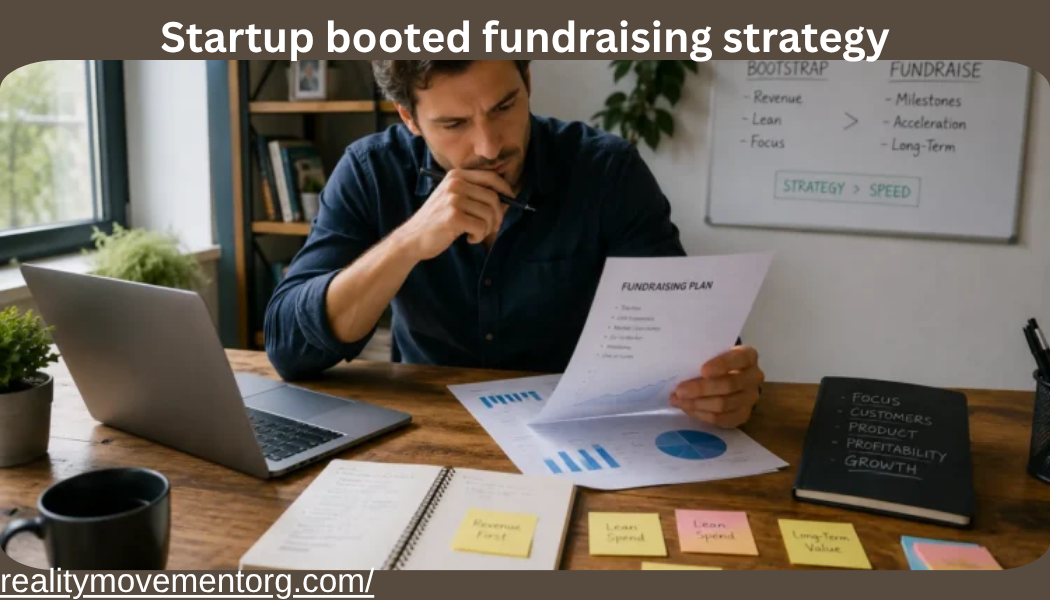
Startup Booted Fundraising Strategy: The Complete Guide to Growing Your Startup with Bootstrapping and Smart Fundraising
Starting a business has never been easier, but growing one into a successful company remains a major challenge. Every entrepreneur eventually faces the same question: How can I fund my startup without losing control or running out of money?
Traditionally, startups followed one of two paths. Some founders bootstrapped their businesses using personal savings and revenue, while others immediately sought outside investment from angel investors or venture capital firms.
Today, a more balanced approach is becoming increasingly popular—the startup booted fundraising strategy.
This strategy combines the strengths of bootstrapping with carefully planned fundraising. Instead of depending entirely on personal money or immediately giving away equity, founders first validate their business, generate early revenue, build customer trust, and then raise investment when the business is in a stronger position.
This approach allows entrepreneurs to maintain greater ownership, negotiate better investment terms, reduce financial risk, and create sustainable long-term growth.
In this guide, you’ll learn everything about the startup booted fundraising strategy, including how it works, why investors appreciate it, the best funding sources, key financial metrics, and practical steps to prepare your startup for long-term success.
What Is a Startup Booted Fundraising Strategy?
A startup booted fundraising strategy is a business growth approach that combines bootstrapping with planned fundraising.
Rather than relying entirely on outside investors from the beginning, founders initially finance the business through personal resources, early customer revenue, or limited external support. Once the startup demonstrates market demand and business potential, it strategically raises additional capital to accelerate growth.

This hybrid model offers the best of both worlds:
- Greater founder ownership
- Stronger financial discipline
- Better investor confidence
- Lower dilution
- Sustainable scaling
Instead of raising money simply because it is available, startups raise capital only when it creates measurable business value.
Also read:Schoology Alfa: The Complete Guide to the Next Generation Digital Learning Experience
Understanding Bootstrapping
Bootstrapping means building a business using resources already available.
Founders commonly use:
- Personal savings
- Business revenue
- Freelance income
- Family support
- Small business profits
- Existing assets
The objective is to grow without depending heavily on investors.
Bootstrapped startups often become more disciplined because every dollar must generate meaningful results.
Understanding Fundraising
Fundraising involves obtaining financial support from external sources.
Common fundraising options include:
- Angel investors
- Venture capital firms
- Crowdfunding
- Startup accelerators
- Government grants
- Bank loans
- Revenue-based financing
- Strategic partnerships
Each funding source offers different advantages depending on the startup’s stage.
Why Combine Bootstrapping and Fundraising?
Many founders believe they must choose between complete independence and outside investment.
In reality, combining both approaches often creates stronger businesses.
Early bootstrapping allows founders to:
- Validate ideas
- Build customers
- Improve products
- Understand the market
- Develop efficient operations
Later fundraising provides resources for:
- Hiring talent
- Marketing
- Product development
- Geographic expansion
- Technology investments
This combination reduces unnecessary risk while improving growth potential.
Why the Startup Booted Fundraising Strategy Is Growing
Several business trends have increased interest in this approach.
Higher Investor Expectations
Investors today expect startups to demonstrate traction before investing.
They often look for:
- Revenue
- Customer growth
- Product-market fit
- Retention
- Efficient spending
Bootstrapping helps founders develop these strengths before fundraising.
Rising Startup Costs
Although technology has reduced some startup expenses, customer acquisition, software development, and talent remain expensive.
Strategic fundraising helps finance these larger growth initiatives.
Greater Focus on Sustainable Growth
Many investors now prioritize sustainable business models instead of rapid but unprofitable expansion.
A startup booted fundraising strategy naturally supports disciplined growth.
The Core Principles of a Startup Booted Fundraising Strategy
Several principles define this approach.
Build Before Raising
Founders first create value before seeking investment.
This may include:
- Building a prototype
- Launching a product
- Acquiring customers
- Generating revenue
- Validating demand
Early progress improves fundraising opportunities.
Maintain Financial Discipline
Bootstrapping teaches careful financial management.
Successful founders focus spending on activities that generate measurable returns.
Raise Capital with Purpose
Funding should solve specific business challenges rather than simply increasing the bank balance.
Every investment should support a clearly defined growth objective.
Protect Founder Ownership
By delaying fundraising until the business gains value, founders often retain larger ownership stakes.
Benefits of a Startup Booted Fundraising Strategy
Better Negotiating Power
Startups with customers and revenue usually negotiate stronger investment terms.
Investors perceive them as lower-risk opportunities.
Higher Company Valuation
Businesses demonstrating market traction often receive higher valuations.
This reduces founder equity dilution.
Improved Financial Management
Bootstrapped companies typically develop efficient operating habits.
This discipline continues even after fundraising.
Stronger Investor Confidence
Investors appreciate founders who can build successful businesses with limited resources.
It demonstrates resilience and leadership.
Reduced Dependence on External Capital
Generating revenue reduces pressure to raise investment repeatedly.
Challenges of This Strategy
Although highly effective, this approach also presents challenges.
Slower Initial Growth
Limited resources may delay hiring, marketing, and expansion.
Greater Founder Responsibility
Founders often perform multiple roles simultaneously.
Cash Flow Pressure
Managing limited cash requires careful budgeting.
Longer Development Timelines
Some products require significant investment before generating revenue.
Planning becomes essential.
Startup Growth Stages
Understanding business stages helps determine when fundraising becomes appropriate.
Idea Stage
The founder identifies a business problem and develops a solution.
Funding usually comes from personal resources.
Validation Stage
The startup tests customer demand.
Goals include:
- Customer interviews
- Minimum Viable Product (MVP)
- Early feedback
- Product improvements
Revenue Stage
Customers begin purchasing products or services.
Revenue demonstrates market demand.
Growth Stage
The startup expands operations, marketing, and hiring.
Outside funding often becomes valuable during this stage.
Scaling Stage
The company enters new markets, launches additional products, or grows internationally.
Larger fundraising rounds may support expansion.
Building a Strong Financial Foundation
Successful fundraising begins with financial preparation.
Founders should understand:
- Monthly expenses
- Revenue growth
- Profit margins
- Customer acquisition costs
- Cash runway
- Burn rate
Strong financial visibility improves business decisions.
Why Revenue Matters Before Fundraising
Revenue proves customers are willing to pay.
Investors generally prefer startups with paying customers because revenue reduces uncertainty.
Even modest revenue demonstrates:
- Product demand
- Customer trust
- Business viability
- Market validation
Revenue often becomes one of the strongest fundraising assets.
Validating Product-Market Fit
Product-market fit means customers genuinely value the product.
Signs include:
- Repeat purchases
- Positive reviews
- Customer referrals
- Low churn
- Growing demand
- Increasing engagement
Startups achieving product-market fit become significantly more attractive to investors.
Preparing an Investor-Ready Startup
Before raising capital, founders should strengthen several business areas.
Business Model
Investors want to understand how the company generates revenue.
Customer Growth
Steady customer acquisition demonstrates market demand.
Financial Records
Accurate financial reporting builds investor confidence.
Market Research
Founders should clearly explain:
- Market size
- Target audience
- Competitors
- Competitive advantages
Growth Strategy
Investors expect a realistic expansion plan supported by measurable objectives.
Key Metrics Investors Evaluate
Investors rely on data rather than assumptions.
Important startup metrics include:
Monthly Recurring Revenue (MRR)
Consistent monthly revenue indicates predictable business performance.
Annual Recurring Revenue (ARR)
ARR measures recurring revenue over one year.
Customer Acquisition Cost (CAC)
CAC calculates the cost of acquiring each customer.
Lower acquisition costs generally improve profitability.
Customer Lifetime Value (CLV)
CLV estimates total revenue generated throughout a customer’s relationship with the business.
Burn Rate
Burn rate measures how quickly a startup spends available cash.
Runway
Runway estimates how many months the company can operate before requiring additional funding.
Common Funding Sources
A startup booted fundraising strategy may use several financing options.
Personal Savings
Many founders begin with their own money.
Friends and Family
Early supporters sometimes provide initial funding.
Angel Investors
Angel investors often support promising early-stage startups.
Venture Capital
VC firms invest larger amounts into startups with significant growth potential.
Crowdfunding
Crowdfunding allows businesses to raise smaller investments from many supporters.
Government Grants
Some industries qualify for grants that do not require equity repayment.
Revenue-Based Financing
Repayment depends on future business revenue rather than fixed monthly payments.
Strategic Partnerships
Established companies sometimes invest in startups that complement their business objectives.
Why Investors Appreciate Bootstrapped Founders
Investors increasingly recognize the advantages of founders who successfully bootstrap before fundraising.
These entrepreneurs often demonstrate:
- Financial discipline
- Resourcefulness
- Market validation
- Customer understanding
- Operational efficiency
- Long-term thinking
These qualities reduce investment risk while increasing confidence in future growth.
Step-by-Step Startup Booted Fundraising Strategy Framework
A successful startup booted fundraising strategy follows a structured path instead of raising money at every opportunity. Each stage builds a stronger business and improves the startup’s ability to attract investors on favorable terms.
Step 1: Solve a Real Market Problem
Every successful startup begins by solving a genuine customer problem.
Before spending significant money, founders should answer questions such as:
- What problem exists?
- Who experiences this problem?
- How serious is it?
- Are customers willing to pay for a solution?
A business built around a real need has a much higher chance of long-term success.
Step 2: Build a Minimum Viable Product (MVP)
Instead of developing a perfect product, launch a simple version that demonstrates the core value.
An MVP allows founders to:
- Test customer interest
- Collect feedback
- Improve features
- Reduce development costs
- Validate assumptions
Early customer feedback is often more valuable than internal opinions.
Step 3: Acquire Early Customers
Before raising outside funding, focus on attracting real users.
Methods include:
- Content marketing
- Social media
- Email marketing
- Networking
- Industry events
- Referral programs
- Search engine optimization (SEO)
Customers provide both revenue and valuable product feedback.
Step 4: Optimize Cash Flow
Revenue alone is not enough.
Founders should carefully manage:
- Operating expenses
- Marketing budgets
- Payroll
- Software subscriptions
- Inventory costs
- Emergency reserves
Positive cash flow demonstrates financial discipline.
Step 5: Raise Capital at the Right Time
Fundraising should support a specific growth objective.
Examples include:
- Expanding into new markets
- Hiring specialized talent
- Scaling marketing
- Accelerating product development
- Building infrastructure
Raising capital without a clear purpose often leads to unnecessary spending.
Preparing an Effective Investor Pitch
Investors expect founders to present clear, evidence-based business opportunities.
A strong pitch typically covers:
The Problem
Explain the customer challenge clearly.
The Solution
Demonstrate how your product solves the problem.
Market Opportunity
Show the size of the target market.
Business Model
Explain how revenue is generated.
Competitive Advantage
Highlight what makes the startup different.
Traction
Share measurable progress, such as:
- Revenue
- Customer growth
- User engagement
- Partnerships
- Retention rates
Financial Projections
Present realistic growth expectations supported by data.
Funding Request
Clearly explain:
- How much funding is needed
- How it will be used
- Expected outcomes
Best Practices for a Startup Booted Fundraising Strategy
Focus on Profitability Early
Revenue without profitability creates long-term challenges.
Building a sustainable business increases investor confidence.
Build Strong Customer Relationships
Satisfied customers often become repeat buyers and referral sources.
Strong customer loyalty improves business stability.
Measure Everything
Track important business metrics regularly.
Data-driven decisions reduce uncertainty.
Maintain Lean Operations
Avoid unnecessary expenses.
Invest only in activities that support growth.
Strengthen Your Team
A skilled and motivated team increases investor confidence.
People remain one of the most important startup assets.
Common Mistakes to Avoid
Raising Money Too Early
Seeking investment before validating the business often leads to lower valuations and greater equity dilution.
Also read:Trucofax: Everything You Need to Know About This Popular Internet Keyword
Growing Too Quickly
Rapid expansion without strong operational systems may create financial strain.
Ignoring Customer Feedback
Customers help identify product improvements and market opportunities.
Ignoring feedback slows growth.
Poor Financial Planning
Inaccurate budgets reduce investor confidence.
Founders should maintain organized financial records.
Depending on One Funding Source
Diversifying funding options increases financial flexibility.
Financial Planning for Long-Term Growth
Financial planning supports sustainable expansion.
Important areas include:
Revenue Forecasting
Estimate future income based on realistic assumptions.
Expense Management
Control fixed and variable costs.
Cash Flow Monitoring
Track money entering and leaving the business.
Emergency Funding
Maintain reserves for unexpected challenges.
Investment Planning
Allocate resources toward activities that generate measurable returns.
Using Artificial Intelligence in Modern Fundraising
Artificial intelligence is changing how startups prepare for fundraising.
AI tools help founders:
- Analyze financial data
- Build investor presentations
- Improve market research
- Predict customer behavior
- Create financial forecasts
- Automate reporting
- Improve customer support
AI should support decision-making rather than replace strategic thinking.
Technology That Supports Startup Growth
Modern startups benefit from numerous digital tools.
Common categories include:
Customer Relationship Management (CRM)
CRM software organizes customer interactions and sales opportunities.
Accounting Software
Financial platforms simplify bookkeeping, budgeting, and reporting.
Project Management Tools
Collaboration software improves productivity across teams.
Marketing Automation
Automation platforms support email marketing, customer segmentation, and campaign management.
Business Analytics
Analytics tools measure customer behavior, sales performance, and operational efficiency.
Future Trends in Startup Booted Fundraising Strategy
The startup funding landscape continues evolving.
Several trends are shaping the future.
Greater Investor Focus on Profitability
Investors increasingly prefer startups demonstrating sustainable business models rather than rapid but unprofitable growth.
AI-Driven Decision Making
Artificial intelligence will improve financial forecasting and investment analysis.
Revenue-Based Financing
Alternative financing models continue gaining popularity because they reduce founder dilution.
Community-Led Growth
Building engaged customer communities strengthens long-term business success.
Global Investment Opportunities
Digital communication enables startups to connect with investors worldwide.
Climate and Sustainability Investments
Investors increasingly support startups addressing environmental and social challenges.
How to Decide When to Raise Funding
Not every startup needs outside investment immediately.
Consider fundraising when:
- Product-market fit has been validated.
- Revenue is growing consistently.
- Customer demand exceeds current capacity.
- Expansion opportunities exist.
- The return on investment is clearly measurable.
Waiting until the business demonstrates strong fundamentals often leads to better investment terms.
Expert Analysis: Why This Strategy Works
The startup booted fundraising strategy succeeds because it balances financial discipline with strategic growth.
Bootstrapping encourages founders to:
- Understand customers deeply.
- Spend carefully.
- Build efficient operations.
- Validate market demand.
Fundraising then provides the capital needed to accelerate proven business models.
This combination reduces risk for both founders and investors.
Companies following this strategy often develop stronger cultures because early resource limitations encourage creativity, accountability, and innovation.
Rather than chasing investment, founders focus first on creating genuine customer value.
That mindset frequently leads to healthier long-term businesses.
Action Plan for Founders
Entrepreneurs considering a startup booted fundraising strategy can follow this practical roadmap:
- Identify a meaningful customer problem.
- Develop a simple MVP.
- Test the market with real users.
- Collect customer feedback.
- Improve the product continuously.
- Generate recurring revenue.
- Monitor financial metrics.
- Build an experienced team.
- Strengthen business processes.
- Raise investment only when it accelerates validated growth.
Following this sequence creates stronger businesses while preserving founder ownership.
Why Sustainable Growth Matters More Than Fast Growth
Many startups focus on rapid expansion without establishing stable business foundations.
Sustainable growth emphasizes:
- Customer satisfaction
- Healthy cash flow
- Operational efficiency
- Product quality
- Employee development
- Long-term profitability
Businesses that grow sustainably are often better prepared for changing market conditions.
Conclusion
A startup booted fundraising strategy combines the financial discipline of bootstrapping with the growth potential of strategic fundraising. Instead of relying entirely on external investment from the beginning, founders first validate their ideas, build customer trust, generate revenue, and strengthen their business foundations before seeking additional capital.
This balanced approach improves negotiating power, reduces unnecessary equity dilution, and demonstrates the resilience and resourcefulness that investors value. By focusing on customer needs, maintaining careful financial management, and raising funds only when they support measurable business goals, startups can achieve sustainable growth while retaining greater control over their future.
As investment markets continue evolving, founders who combine smart bootstrapping with well-planned fundraising will be better positioned to build resilient, scalable, and successful businesses. The startup booted fundraising strategy is not simply a financing method—it is a long-term mindset that prioritizes value creation, strategic decision-making, and lasting business success.
Frequently Asked Questions
Is a startup booted fundraising strategy suitable for every type of startup?
Not always. Businesses requiring significant upfront investment, such as biotechnology or advanced manufacturing, may need external funding earlier. However, many software, service, and digital startups benefit from this hybrid approach.
How long should a startup bootstrap before raising investment?
There is no fixed timeline. Many founders wait until they achieve product-market fit, consistent customer growth, or recurring revenue that demonstrates business potential.
Can founders use multiple fundraising methods together?
Yes. Many startups combine personal investment, grants, angel funding, crowdfunding, and revenue-based financing to create a balanced funding strategy while minimizing ownership dilution.
What is the biggest advantage of delaying fundraising?
Waiting until the business has validated its market and generated traction often results in higher company valuations, stronger negotiating power, and better investment terms.
How does a startup booted fundraising strategy support long-term success?
By encouraging financial discipline, customer-focused development, and strategic investment decisions, this approach helps startups build stronger business foundations that can support sustainable growth even as markets and funding conditions change.