CDiPhone Explained: What It Means, How It Works, and How to Connect CDs With an iPhone
CDiPhone is a modern internet term that combines “CD” with “iPhone.” At first glance, it sounds like the name of an Apple product, but that is where much of the confusion begins. There is no confirmed Apple product officially called CDiPhone. Instead, the term is used online to describe a concept, a possible connection between compact discs and iPhones, or practical methods for moving music from CDs onto an iPhone.
This distinction is important because many online pages describe CDiPhone as though it were a released smartphone with built-in CD hardware. Other pages describe it as a futuristic concept involving physical media, local storage, cloud services, artificial intelligence, and advanced file management. Still others use the word simply to describe the process of transferring CD music to an iPhone.
The most reliable way to understand CDiPhone is therefore to look at all of these meanings separately.
The basic idea is easy to understand. CDs represent physical ownership and offline media. The iPhone represents modern mobile computing, digital music, apps, wireless connectivity, and portable storage. CDiPhone sits between these two worlds as a concept for connecting older physical media with modern mobile technology.
This topic is also interesting because it reflects a larger change in technology. Music moved from CDs to MP3 players, then to smartphones, and later to streaming platforms. Yet physical media has not disappeared completely. Many people still own large CD collections, including albums, special editions, live recordings, rare releases, and music that may not be available on every streaming service.
For those users, putting CD music on an iPhone can be practical.
This comprehensive guide explains what CDiPhone means, whether it is a real Apple product, how the concept developed, how CD music can actually be moved to an iPhone, what the imagined hardware might look like, the benefits and limitations of physical media, privacy and storage considerations, audio quality, and what the future of hybrid physical-digital technology could look like.
What Is CDiPhone?
CDiPhone is not a standard technical term or an official Apple product name.
Instead, it is an informal expression used online for ideas that connect compact discs with Apple’s iPhone ecosystem. Recent online discussions generally use the term in several ways, including transferring CD music to an iPhone and imagining a future smartphone capable of working directly with physical discs.
The simplest definition is:
CDiPhone describes the idea of bringing CD-based media into an iPhone-centered digital experience.
This can happen through practical methods that already exist, such as importing music from a CD using a computer and then syncing the resulting digital files with an iPhone.
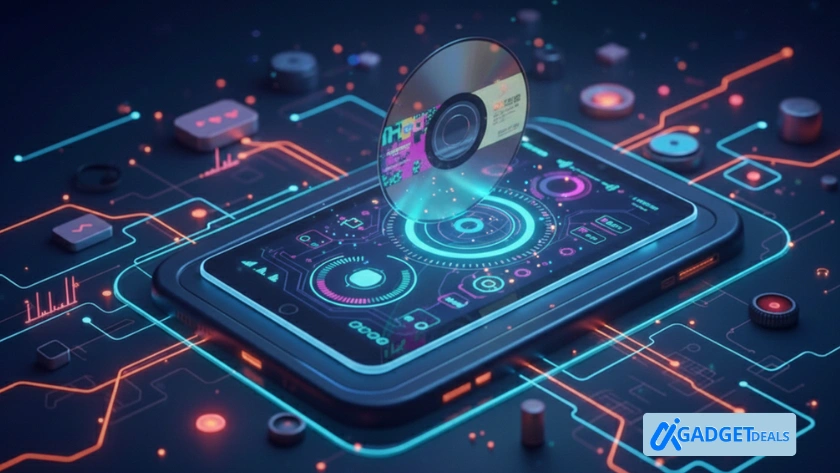
It can also refer to a fictional or futuristic device that physically combines CD technology with smartphone hardware.
These are very different things.
One is a real workflow.
The other is a technology concept.
Is CDiPhone a Real Apple Product?
No confirmed Apple product called CDiPhone has been announced by Apple.
This is one of the most important facts to understand before reading online claims about the term. Several recent articles describe CDiPhone as a concept rather than an actual Apple device, and some specifically point out that Apple has not announced an iPhone with a built-in CD drive.
That means readers should be careful with articles claiming that CDiPhone has:
- An official Apple model number
- A confirmed release date
- An official Apple price
- A built-in CD drive
- A confirmed Apple processor
- Official tri-layered storage
- An announced AI storage system
Those specifications should not be treated as real product specifications unless Apple itself confirms them.
Some online articles have presented detailed technical features as part of the CDiPhone concept. These include theoretical storage architectures, AI file management, lossless audio support, and physical disc modules. Such descriptions are best understood as imagined specifications rather than confirmed Apple hardware.
Why Are People Searching for CDiPhone?
The popularity of the term reflects an interesting combination of nostalgia and modern technology.
Many people grew up with CDs.
They remember buying albums from stores, opening jewel cases, reading album booklets, and creating personal music collections.
Today, most people listen to music through smartphones and streaming services.
That creates an interesting question:
Can the physical CD experience be brought into the smartphone age?
CDiPhone represents an answer to that question at the conceptual level.
It combines two very different technology eras:
- Physical music ownership
- Mobile digital convenience
This makes the term attractive to technology enthusiasts, music collectors, audiophiles, and people who still have large CD collections.
The Connection Between CDs and iPhones
CDs and iPhones represent two important stages in the history of personal music.
CDs made digital music widely available in a physical format.
The iPhone later made digital music part of a much larger mobile computing experience.
The transition was gradual.
People moved from CDs to digital files.
Digital files moved from computers to portable MP3 players.
The iPod helped make digital music highly portable.
The iPhone then combined music playback with communication, internet access, photography, applications, and many other functions.
CDiPhone can therefore be viewed as a symbolic bridge between the physical-media era and the smartphone era.
A Short History of Compact Discs
Compact discs became a major consumer music format during the 1980s and remained important for many years.
Compared with cassette tapes, CDs offered several advantages.
They provided digital audio.
They did not require magnetic tape.
They allowed users to skip tracks easily.
They were relatively compact.
They became popular for both music and computer data.
For many consumers, buying a CD also meant owning a physical copy of an album.
That sense of ownership remains important to some collectors.
The Rise of Digital Music
The digital music revolution changed the role of CDs.
Instead of carrying several physical albums, a person could carry hundreds or thousands of digital tracks.
This became especially useful with portable music players.
Apple’s iPod played a major role in this transition.
Later, the iPhone combined phone functionality, internet access, and digital media into one device.
This made carrying physical music less necessary.
Why CDs Still Matter
The decline of CDs does not mean they have no value.
People continue to keep CDs for several reasons.
Some enjoy collecting physical albums.
Some want permanent access to music they purchased.
Some own rare recordings.
Some prefer the sound of their personal CD collection.
Others simply enjoy the physical experience.
There is also a practical reason.
A CD does not require an active internet connection to play once the music has been properly accessed and transferred.
CD Ownership and Streaming Are Different
Streaming provides convenience.
A user can search for an album and begin listening almost immediately.
However, streaming is based on access rather than traditional physical ownership.
Music catalogs can change.
Albums can disappear.
Licensing arrangements can change.
Regional availability can differ.
A CD collection does not work this way.
If you own the disc, you physically possess the recording.
That difference is one reason the CDiPhone concept continues to attract attention.
How CD Music Can Actually Reach an iPhone
Although a CDiPhone device is not an official Apple product, you can still move music from CDs into an iPhone-based music library.
The general workflow is:
- Read the CD using a compatible computer and optical drive.
- Import or rip the music into digital audio files.
- Organize the tracks and album information.
- Add the music to a compatible music library.
- Sync or transfer the files to the iPhone.
- Play the music from the phone.
This is the practical version of the CDiPhone idea.
It does not require a special CDiPhone device.
What Does “Ripping a CD” Mean?
Ripping a CD means copying the audio data from the physical disc into digital files.
The process does not physically damage the CD.
Instead, the computer reads the audio information and creates a digital copy.
The resulting files can then be organized, backed up, and transferred to compatible devices.
This is how many people historically moved CD collections into digital music libraries.
Why a Computer Is Often Useful
A computer can provide a much easier environment for managing a CD collection.
Desktop and laptop computers can work with external optical drives.
They also offer larger screens and more storage.
This makes it easier to:
- Import multiple albums
- Edit metadata
- Organize artists
- Create playlists
- Back up files
- Check audio formats
- Transfer music
An iPhone itself does not have a built-in optical CD drive.
That is one of the main reasons the practical CDiPhone workflow generally involves another device.
External CD Drives and iPhones
It may sound simple to connect a USB CD drive directly to an iPhone.
In practice, this is more complicated than connecting a normal storage accessory.
A CD drive requires power, optical-drive support, file-system handling, and software capable of interpreting the disc.
An iPhone is designed around modern solid-state storage and app-based access rather than built-in optical media.
Therefore, a computer-based workflow is generally easier for ordinary users.
CDiPhone as a Futuristic Hardware Concept
The other major meaning of CDiPhone is a hypothetical smartphone designed to work with physical discs.
This idea is usually presented as a futuristic combination of:
- Smartphone hardware
- Physical media
- Local storage
- Cloud storage
- Intelligent file management
- High-quality audio
Some online concept articles describe a theoretical CDiPhone with a miniature disc mechanism or hybrid storage system. However, these are concepts rather than confirmed Apple specifications.
What Could a Hypothetical CDiPhone Look Like?
A real physical CD mechanism would create major engineering challenges.
A traditional CD is much larger than the internal components normally found in a modern smartphone.
A disc drive also contains moving parts.
It needs space for:
- The disc
- Spindle mechanism
- Optical laser
- Motor
- Protective structure
- Mechanical components
A smartphone is designed to be thin, light, and resistant to movement.
These requirements conflict with traditional optical-drive design.
Why a Built-In CD Drive Would Be Difficult
Modern smartphones are built around solid-state components.
Solid-state storage has no moving parts.
That makes it:
- Fast
- Compact
- Energy efficient
- Resistant to physical movement
A CD mechanism is different.
It uses moving parts and optical reading.
A smartphone with a traditional CD drive would likely be thicker and more complicated.
It could also require more energy.
This is one reason the idea remains more practical as a concept than as a mainstream smartphone feature.
The Idea of Miniature Physical Storage
Some CDiPhone concept articles imagine a much smaller physical disc rather than a standard CD.
That would be a different technology from a traditional audio CD.
A miniature disc could potentially be designed for:
- Archiving
- Offline storage
- Music
- Photos
- Documents
But creating a small, durable, high-capacity optical storage system suitable for smartphones would require significant engineering.
Therefore, theoretical descriptions should not be confused with an existing consumer product.
Tri-Layered Storage in CDiPhone Concepts
One recurring idea in online CDiPhone discussions is “tri-layered storage.”
This generally describes a theoretical combination of:
- Fast local flash storage
- Physical or archival storage
- Cloud storage
The concept is interesting because each layer could serve a different purpose.
Flash storage could handle applications and frequently used files.
Physical storage could hold long-term archives.
Cloud storage could provide remote access and synchronization.
Some concept articles use this model to describe how a hypothetical CDiPhone might work.
It is important to repeat that this is a conceptual architecture, not an officially announced iPhone feature.
Also read:Schedow: Meaning, Uses, Benefits, and the Modern Approach to Smarter Planning
AI File Management in the CDiPhone Concept
Another popular idea is AI-assisted file management.
In theory, artificial intelligence could analyze how a person uses their data.
For example, it might notice that a user regularly opens certain music albums.
The system could then prioritize those files for local access.
It might also identify rarely used files and move them to an archival layer.
This is similar to broader ideas already used in modern computing, where storage systems automatically manage frequently and rarely accessed data.
Why AI Storage Management Could Be Useful
A smartphone contains many types of data.
There are:
- Photos
- Videos
- Music
- Documents
- Apps
- Messages
- Backups
- Temporary files
Managing all of this manually can become difficult.
An intelligent storage system could theoretically organize files based on:
- Frequency of use
- File size
- Importance
- Age
- User preferences
This would be useful in a hybrid physical-digital device.
Lossless Audio and CDiPhone
Music quality is another reason the CDiPhone concept appeals to audiophiles.
CD audio uses uncompressed digital audio data.
When music is transferred to another format, the resulting quality depends on the chosen file format and encoding process.
Lossless formats can preserve the original audio data while using less space than uncompressed audio.
Common examples include:
- ALAC
- FLAC
- AIFF
- WAV
The specific format supported by a device or application matters.
What Is Lossless Audio?
Lossless audio means that the encoded file can reproduce the original digital audio data without the permanent data reduction associated with lossy compression.
This is different from formats designed to make files much smaller by removing some information.
For listeners with good equipment, lossless formats can be attractive because they preserve the source data.
However, the difference may not always be obvious to every listener.
Does a CD Automatically Sound Better Than Streaming?
Not necessarily.
Sound quality depends on many factors.
These include:
- Original recording
- Mastering
- Digital format
- Encoding
- Playback equipment
- Headphones
- Speakers
- Listening environment
A high-quality streaming service can provide excellent sound.
Likewise, a poorly mastered CD may not sound better simply because it is physical.
The real advantage of a CD is not automatically superior sound.
It can also be ownership, physical access, collectability, and control over the original media.
CDiPhone and Offline Listening
Offline access is one of the strongest ideas behind the concept.
Streaming requires access to a service and, in many cases, an internet connection for full functionality.
A locally stored music file can be played without an internet connection.
This can be useful when:
- Traveling
- Flying
- Driving in areas with poor service
- Saving mobile data
- Using music in remote locations
A properly transferred CD library can therefore provide reliable offline listening.
CDiPhone and Cloud Storage
Cloud storage and physical storage do not have to compete.
They can complement each other.
A sensible modern workflow might use:
Physical CD → Digital file → Local iPhone library → Backup
Cloud storage can provide another backup layer.
This approach reduces the risk of losing a music collection.
Why Backup Matters
A CD is physical media.
It can be scratched, lost, damaged, or destroyed.
Digital files can also be lost through:
- Device failure
- Accidental deletion
- Corrupted storage
- Theft
- Software problems
Therefore, owning a CD does not automatically mean the digital copy is safe.
The best strategy is usually to maintain multiple copies of important files.
The 3-2-1 Backup Idea
A useful general backup principle is the 3-2-1 approach.
It suggests keeping:
- Three copies of important data
- On at least two different types of storage
- With one copy stored separately
For a music collection, that might mean:
Original CD
Local digital library
Separate backup
This is much safer than keeping the only digital copy on an iPhone.
CDiPhone and Music Metadata
Metadata is often overlooked when transferring CDs.
Metadata includes information such as:
- Artist
- Album
- Track name
- Genre
- Release year
- Track number
- Album artwork
Good metadata makes a music collection much easier to navigate.
Without metadata, a library may contain dozens of files with generic names.
Why Album Artwork Matters
Album artwork makes digital music feel more like a traditional music collection.
It helps users identify albums visually.
For collectors, artwork can also preserve part of the original CD experience.
A well-organized digital library can therefore combine the convenience of the iPhone with some of the personality of physical media.
CDiPhone and Personal Music Ownership
One of the deeper ideas behind CDiPhone is control.
Streaming is convenient, but a personal digital library gives users more direct control over their files.
Users can organize music according to their own preferences.
They can create backups.
They can choose supported formats.
They can keep albums that are no longer available through certain services.
This is particularly useful for collectors.
The Environmental Question
Physical media has an environmental cost.
CD production requires:
- Raw materials
- Manufacturing
- Packaging
- Transportation
Digital services also use energy through:
- Data centers
- Networks
- Devices
- Cloud infrastructure
Therefore, it is too simplistic to say that physical media is automatically environmentally better or worse.
The environmental impact depends on how media is produced, used, stored, transported, and eventually discarded.
Why Retro Technology Keeps Returning
Technology does not always move in a straight line.
Sometimes old ideas return in new forms.
Vinyl records became popular again.
Mechanical keyboards returned to mainstream attention.
Film photography gained new interest.
Physical books remain popular alongside e-readers.
CDiPhone fits into this larger pattern.
People may want modern convenience without completely abandoning physical ownership.
The Emotional Side of Physical Media
Technology is not only about efficiency.
People also form emotional connections with objects.
A CD may remind someone of:
- A favorite period of life
- A concert
- A relationship
- A family member
- A road trip
- A particular year
- A musical discovery
Digital streaming does not always provide the same physical connection.
That emotional value helps explain why physical media continues to interest some users.
CDiPhone and the Future of Personal Archives
Personal archives may become more important as digital collections grow.
People now accumulate enormous quantities of:
- Photos
- Videos
- Music
- Documents
- Messages
- Creative work
A future storage system could combine local storage, removable media, cloud backups, and intelligent organization.
This is arguably more important than the idea of a literal CD slot.
The deeper CDiPhone concept is about giving people more ways to control and preserve personal data.
What Could a Future Hybrid Device Offer?
If a hybrid physical-digital smartphone were ever developed, it could theoretically offer:
- Removable archival media
- Local-first storage
- Automatic backup
- AI organization
- High-quality audio
- Offline access
- Physical media ownership
- Cloud synchronization
But these features would need to be balanced against cost, size, battery life, durability, and engineering complexity.
Why Apple May Prefer Digital Storage
Modern smartphones benefit from solid-state storage.
It is compact and fast.
A physical optical drive would introduce mechanical complexity.
It would also conflict with the minimalist design philosophy that has shaped modern smartphones.
This does not mean optical storage is impossible.
It simply means that the engineering tradeoffs would be significant.
CDiPhone vs. a Traditional iPhone
A traditional iPhone is designed around:
- Solid-state storage
- Wireless connectivity
- Apps
- Digital media
- Cloud services
- Touch interaction
A hypothetical CDiPhone would add physical media to this ecosystem.
Also read:Voozon: Everything You Need to Know About the Social Platform and Digital Media Website
The difference would therefore be more than a CD slot.
It would require an entirely different approach to storage and media management.
CDiPhone vs. a Portable CD Player
A portable CD player is designed primarily for physical music playback.
A smartphone is designed for many tasks.
A hypothetical CDiPhone would combine both ideas.
It could potentially provide:
- CD playback
- Smartphone functions
- Internet access
- Apps
- Digital storage
- Wireless audio
This would make it much more versatile than a traditional portable CD player.
Is CDiPhone Better Than Streaming?
There is no universal answer.
Streaming is better for discovery and convenience.
A personal CD library can be better for ownership and long-term control.
Many users may benefit from using both.
For example, streaming can be used to discover new music while a personal library preserves favorite albums.
This hybrid approach may be more realistic than expecting one format to replace everything.
Is CDiPhone Better Than an iPhone?
There is currently no official CDiPhone product to compare directly with an iPhone.
If the term refers to the hypothetical concept, the comparison depends on priorities.
A traditional iPhone is practical because it is thin, fast, and designed around modern digital media.
A hypothetical CDiPhone could offer stronger physical-media integration but would likely face engineering challenges.
Common Misunderstandings About CDiPhone
Several misunderstandings appear repeatedly online.
The first is believing that CDiPhone is an official Apple model.
It is not a confirmed Apple product.
The second is believing that every article describing detailed specifications is reporting an Apple announcement.
That is not necessarily true.
The third is assuming that an iPhone can simply play a standard CD without additional hardware or a transfer process.
That is also misleading.
How to Research CDiPhone Safely
If you see a claim about CDiPhone online, ask:
Does the source cite Apple?
Is there an official Apple announcement?
Is there a real model number?
Is the information repeated only by blogs?
Are images clearly labeled as concepts?
Does the article distinguish fact from speculation?
These questions can help separate technology reporting from internet speculation.
How to Recognize a Concept Device
Concept devices often include:
- Futuristic renders
- Unusual hardware
- Imagined specifications
- “Coming soon” language
- AI-generated images
- Hypothetical features
A concept image is not proof that a product exists.
The same rule applies to CDiPhone.
Why AI-Generated Concepts Can Be Confusing
Modern image-generation tools can create extremely realistic product images.
A fake phone can look like an official Apple product.
Readers may therefore believe that a concept image is a leaked photograph.
This is why visual evidence should be checked against official announcements.
A realistic image does not prove that a device exists.
CDiPhone as a Technology Thought Experiment
Perhaps the most useful way to view CDiPhone is as a thought experiment.
It asks:
What would happen if physical media ownership were redesigned for modern smartphones?
That question has value even without an actual product.
It encourages discussion about:
- Data ownership
- Digital preservation
- Offline access
- Storage architecture
- Music quality
- Consumer choice
- Sustainability
- Nostalgia
The Bigger Lesson From CDiPhone
The CDiPhone concept shows that old and new technologies do not always have to be enemies.
A physical CD can coexist with digital files.
A personal library can coexist with streaming.
Local storage can coexist with cloud storage.
Physical ownership can coexist with mobile convenience.
The future of technology may not be about completely replacing older systems. It may sometimes be about connecting them more intelligently.
Final Thoughts
CDiPhone is best understood as an internet term and technology concept rather than a confirmed Apple product. The name combines compact-disc technology with the iPhone and is used online to describe several related ideas, especially transferring CD music into an iPhone-based digital library and imagining a future smartphone that could directly integrate physical media. Current online discussions also mention ideas such as hybrid storage, AI file organization, lossless audio, and offline archives, but these should be treated as conceptual features rather than confirmed Apple specifications.
The practical side of CDiPhone is much more useful today. People who own CDs can already preserve their music by importing the discs into a digital library and then moving compatible files to an iPhone. This approach provides the convenience of smartphone listening while allowing people to keep their personal music collections. The broader concept is also worth considering because it raises important questions about ownership, digital preservation, storage, privacy, and the future of personal media.
The idea of combining physical and digital technology may sound unusual, but technology often develops through this type of combination. People continue to value physical books, vinyl records, printed photographs, and other tangible formats while using modern digital services at the same time. CDiPhone reflects the same desire: modern convenience without completely losing the sense of ownership and permanence associated with physical media.
For now, there is no confirmed Apple device officially called CDiPhone. Anyone interested in the idea should therefore separate real CD-to-iPhone workflows from speculative hardware concepts. That simple distinction makes the topic much easier to understand and prevents attractive online concept stories from being mistaken for official Apple announcements.
Frequently Asked Questions About CDiPhone
Is CDiPhone an official Apple product?
No. There is no confirmed Apple product officially named CDiPhone. The term is generally used online for a concept or for methods of connecting CD music with an iPhone.
Can an iPhone play a CD directly?
An iPhone does not have a built-in CD drive. In a practical CD-to-iPhone workflow, music is normally read from the disc using another compatible device and then transferred to a digital music library.
What does CDiPhone mean?
CDiPhone is an informal term combining “CD” and “iPhone.” It can describe the idea of bringing CD-based music into an iPhone environment or a hypothetical smartphone that directly integrates physical media.
What is tri-layered storage in CDiPhone articles?
Tri-layered storage is a theoretical concept involving different storage levels, such as fast local storage, physical archival storage, and cloud storage. It appears in online CDiPhone concept discussions but is not a confirmed Apple feature.
Does CDiPhone support lossless music?
There is no confirmed CDiPhone device with officially documented audio specifications. Some concept articles imagine lossless audio support, but those descriptions should not be treated as official product specifications.