
Woeken Explained: Meaning, Spelling, Uses, and the Difference Between Woeken and Woken
The word “woeken” is an unusual term that can create confusion because it looks similar to familiar English words such as “woken,” “woken up,” and “wake.” For many people searching for woeken, the main question is simple: Is woeken a correct English word, or is it a spelling mistake?
The answer depends on how the term is being used.
In standard modern English, “woken” is the established past participle of “wake.” For example, someone can say, “I have woken up early today” or “She had woken before sunrise.” The spelling woeken is not the standard English form of this verb.
At the same time, woeken can appear intentionally as a name, username, brand-style term, creative spelling, or emerging online expression. A word does not always have to belong to standard English vocabulary to appear on the internet. Names, usernames, product names, fictional terms, and community-specific expressions can use almost any spelling.
This distinction is important because search engines often show results for unusual words even when those words are not established dictionary entries. A search for woeken may therefore lead to different interpretations depending on the context.
For US readers, the most useful way to understand woeken is to separate standard English from intentional names or emerging terminology. This article explains the meaning, pronunciation, spelling, grammar, possible origins, common confusion, examples, related terms, search intent, and practical usage of woeken.
The goal is not simply to label one spelling “right” or “wrong.” Instead, it is to explain why the term appears, how it compares with woken, and how readers can determine which form is appropriate in a particular sentence.
What Does Woeken Mean?
Woeken does not have an established standard meaning in everyday modern English comparable to words such as wake, woke, or woken.
If you encounter woeken in ordinary English writing, the most likely explanation is that it is either:
- A misspelling of woken
- An intentional name
- A username
- A creative spelling
- A niche or emerging online term
- A word from another language or language variety
- A fictional or invented expression
Context is therefore extremely important.
If someone writes, “I have woeken up early,” they probably intended to write “I have woken up early.”
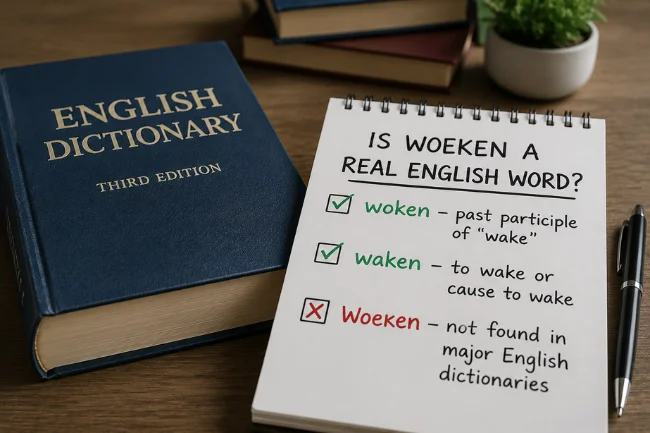
However, if Woeken appears as the name of a company, character, project, account, or product, changing it to woken may be incorrect because names can have their own spelling.
Is Woeken a Correct English Word?
In standard English, woeken is not the normal past participle of wake.
The standard form is woken.
The basic verb forms are:
- Wake
- Woke
- Woken
- Waking
For example:
“I wake up at seven.”
“Yesterday, I woke up at seven.”
“I have woken up several times.”
“I am waking up early this week.”
The form woeken does not belong to this standard conjugation.
This is one of the most important points for students, writers, editors, and anyone trying to improve English spelling.
Woeken vs. Woken
The difference between woeken and woken is mainly a spelling difference when the writer intends to discuss the verb wake.
| Form | Standard English? | Typical use |
| Wake | Yes | Present/base form |
| Woke | Yes | Simple past |
| Woken | Yes | Past participle |
| Waking | Yes | Present participle |
| Woeken | No, not as the standard form of wake | Possible misspelling, name, or invented term |
The correct choice in ordinary English grammar is woken.
What Does Woken Mean?
Woken is the past participle of wake.
The verb wake has several meanings.
The most common meaning is to stop sleeping.
For example:
“I have woken up early.”
“She has woken several times tonight.”
“They had woken before the alarm.”
Woken can also appear in other meanings of wake, including becoming aware of something or being brought into an alert state.
The exact meaning depends on context.
The Verb Wake and Its Forms
Understanding the full verb makes the spelling easier to remember.
The base form is wake.
The simple past is woke.
The past participle is woken.
The -ing form is waking.
Examples include:
“I wake up at six.”
“I woke up late yesterday.”
“I have woken up early all week.”
“I am waking up earlier now.”
This pattern is irregular because the past tense is not formed by simply adding “-ed.”
You do not say “waked” in the usual sense of getting out of sleep when using standard everyday English.
Why Do People Write Woeken?
There are several reasons someone might write woeken instead of woken.
One reason is pronunciation.
English spelling is not always predictable from pronunciation. People sometimes try to spell a word according to how they think it sounds.
Another reason is visual confusion.
The sequence of letters in woken may feel unusual to someone learning English.
A third reason is influence from other languages.
People who speak languages where similar vowel combinations are common may naturally produce different spellings.
A fourth reason is typing.
When people type quickly, unusual spellings can appear accidentally.
The Role of English Pronunciation
Pronunciation can create spelling problems because English does not have a perfectly regular relationship between letters and sounds.
The word woken is generally pronounced approximately like:
WOH-kən
The first syllable sounds similar to “woe.”
The second syllable is weak, often sounding like “kuhn” or “kən.”
Because the pronunciation does not clearly reveal every letter, learners may try different spellings.
This is one reason unusual forms such as woeken can appear.
How to Pronounce Woken
For most American English speakers, woken is pronounced approximately:
/ˈwoʊ.kən/
The first syllable receives the main stress.
You can think of it as:
WOH-kuhn
The pronunciation of woeken, if someone uses it as a personal or invented name, may be different because names can have their own pronunciation.
Therefore, it is not always safe to assume that every use of Woeken should be pronounced exactly like woken.
Why Woken Is Easy to Misspell
Woken belongs to a group of irregular English verb forms.
Learners often expect English verbs to follow a simple pattern.
For regular verbs:
Walk → walked
Play → played
Jump → jumped
But irregular verbs work differently.
Wake → woke → woken
This makes the word harder to predict.
When people are unsure, they may produce a spelling that looks logical to them.
Woeken is one possible result.
Common Misspellings Related to Woken
People can make several mistakes when writing woken.
Some possible incorrect forms include:
- Woeken
- Wokenn
- Wokun
- Wokened
- Wokein
- Wokin
- Wokenn
These forms are not standard replacements for woken.
The best way to avoid confusion is to remember the three main forms:
Wake → Woke → Woken
When Should You Use Woken?
Use woken when you need the past participle of wake.
It commonly appears with auxiliary verbs such as:
- Have
- Has
- Had
- Be
- Been
For example:
“I have woken up early.”
“She has woken from her sleep.”
“They had woken before the storm.”
This is different from simple past usage.
You would normally say:
“I woke up early yesterday.”
Not:
“I woken up early yesterday.”
Woke vs. Woken
This is another important distinction.
Woke is the simple past form.
Woken is the past participle.
Compare:
“I woke up at six.”
“I have woken up at six every day this week.”
The first sentence uses simple past.
The second uses the past participle after “have.”
This grammar pattern is useful for anyone who is learning English.
Waking vs. Woken
Waking is the present participle or gerund form.
For example:
“I am waking up earlier.”
“She was waking slowly.”
“Waking up early can be difficult.”
Woken is different.
“I have woken up.”
The two forms should not be mixed.
Examples of Correct Woken Usage
Here are simple examples:
“I have woken up before my alarm.”
“She has woken from a deep sleep.”
“The baby had woken several times.”
“We have woken early every morning.”
“He had already woken when I called.”
These examples show how woken works naturally in standard English.
Examples of Incorrect Woeken Usage
If woeken is being used as an accidental spelling of woken, these sentences should be corrected.
Incorrect:
“I have woeken up early.”
Correct:
“I have woken up early.”
Incorrect:
“She had woeken before sunrise.”
Correct:
“She had woken before sunrise.”
Incorrect:
“They have woeken several times.”
Correct:
“They have woken several times.”
The important point is that the correction is based on grammatical function.
When Woeken May Be Intentional
Not every appearance of woeken is necessarily an error.
Words used as names can be intentionally unusual.
For example, a fictional character could be named Woeken.
A digital project could use Woeken as its brand name.
A gaming username might be Woeken.
An artist could choose Woeken as a stage name.
In these cases, changing the spelling would remove the intended identity.
This is why context matters.
Woeken as a Name
If Woeken is being used as a proper name, it should normally be preserved exactly as the owner or creator spells it.
For example:
“Woeken is the name of the character.”
In this sentence, Woeken is not being used as the verb wake.
It is functioning as a name.
The spelling therefore does not need to follow standard English verb rules.
Woeken as a Username
Online usernames often use unusual combinations of letters.
Users create distinctive names because common usernames may already be taken.
A person may choose Woeken because:
- It looks unique.
- It is easy to recognize.
- It has personal meaning.
- It is available across platforms.
- It represents a creative identity.
In such cases, calling it a misspelling may be inaccurate.
Woeken as a Brand
Brands frequently use invented words.
A brand name does not have to be a traditional dictionary word.
Companies may create names that are:
- Short
- Memorable
- Distinctive
- Easy to trademark
- Easy to search
- Different from competitors
If a company intentionally uses Woeken, its branding should not automatically be changed to Woken.
Woeken in Creative Writing
Writers can invent words.
Fantasy novels, science-fiction stories, games, films, and fictional worlds often contain terms that do not exist in standard English.
Also read:Schedow: Meaning, Uses, Benefits, and the Modern Approach to Smarter Planning
Woeken could theoretically be used as:
- A character name
- A location
- A fictional language
- A magical object
- A technology
- A cultural term
The meaning would then come from the story.
Woeken and Online Language
The internet creates new words constantly.
Some disappear quickly.
Others become popular.
Some remain limited to a small community.
This process makes online vocabulary difficult to classify.
An emerging term may not have a clear dictionary definition yet.
That does not necessarily mean the term is meaningless.
It may simply be too new, too limited, or too specialized to have a stable definition.
How New Words Become Established
Words can move through several stages.
First, someone creates or uses a new expression.
Then a small group adopts it.
If the term spreads, more people begin using it.
Media and social platforms may increase visibility.
Eventually, dictionaries or language researchers may document it.
However, most new internet words never reach the final stage.
This is why an unusual keyword like woeken should be approached carefully.
Woeken and Search Engines
Search engines collect enormous amounts of information.

They may return results for:
- Names
- Misspellings
- Rare terms
- Usernames
- Product names
- Newly created words
- Foreign-language terms
The fact that a search engine returns results for a word does not prove that the word is standard English.
This is a very important distinction.
Search Results Are Not Dictionaries
A search engine answers searches.
A dictionary documents language.
These are different functions.
If you search for woeken and find thousands of pages, that does not automatically establish it as a standard English word.
Likewise, a word can be real even if it has very few search results.
This is especially true for proper names and niche terminology.
How to Determine Whether Woeken Is a Misspelling
Use context.
Ask:
Is Woeken inside a normal English sentence?
Does it describe an action involving sleep?
Is it being used after “have,” “has,” or “had”?
Is it a person’s name?
Is it a company name?
Is it a username?
Is it a fictional term?
If the sentence is:
“I have woeken up late.”
the intended word is almost certainly woken.
If the sentence says:
“Woeken is the name of the new project.”
then Woeken may be intentionally spelled that way.
Woeken and the Word Woke
The relationship between woeken and woke can also create confusion.
Woke has two important modern uses.
First, it is the past tense of wake.
Example:
“I woke up early.”
Second, woke is widely used in modern social and political language to describe awareness of social issues.
These meanings are different but related historically.
Woeken is not the standard form for either meaning.
Woken in Modern American English
In American English, woken is common in perfect constructions.
Examples include:
“I have woken up early.”
“She had woken before anyone else.”
“He has woken from the dream.”
However, American speakers also frequently use “woke up” in simple past sentences.
For example:
“I woke up at seven.”
This makes the difference between woke and woken especially useful to understand.
British and American Usage
Both American and British English use wake, woke, and woken.
There can be differences in preferred constructions and pronunciation, but woken remains a standard form.
For learners, the important rule is simple:
Wake is the base form.
Woke is the past tense.
Woken is the past participle.
The History of Wake
The verb wake has a very old history.
It is related to older Germanic words connected with being awake and becoming conscious.
Many modern English irregular verbs preserve patterns that developed centuries ago.
This helps explain why the forms do not always look predictable.
English inherited many irregular verbs rather than creating entirely new regular patterns.
Why English Has Irregular Verbs
Irregular verbs are often remnants of older language patterns.
Words such as:
Go → went → gone
Sing → sang → sung
Write → wrote → written
Wake → woke → woken
do not follow the regular “-ed” pattern.
Learners often find these forms difficult because they must be remembered rather than generated automatically.
A Simple Memory Trick for Woken
One easy way to remember the correct form is:
Wake today.
Woke yesterday.
Woken with have or had.
For example:
“I wake early.”
“I woke early.”
“I have woken early.”
This simple pattern can help prevent the woeken spelling mistake.
Woeken in Professional Writing
Professional writers should normally use woken when referring to the verb wake.
This includes:
- Business writing
- Academic writing
- News writing
- Emails
- Reports
- School assignments
- Website content
- Formal documents
Using woeken as a spelling mistake can make otherwise polished writing appear careless.
Woeken in Casual Communication
Casual messages often contain spelling mistakes.
A person may write woeken accidentally while texting or posting online.
In casual conversation, readers may understand the intended meaning.
However, if the text is going to be published or shared professionally, it should be corrected.
Woeken and Autocorrect
Technology can sometimes create unusual spellings.
Autocorrect systems are trained on language data, but uncommon words may confuse them.
If someone frequently uses a unique name such as Woeken, their device may attempt to replace it with a more familiar word.
This is another reason unusual names and standard English should be treated differently.
How Writers Should Handle the Keyword Woeken
If the subject of an article is specifically Woeken, the exact spelling should be preserved when referring to the keyword itself.
At the same time, writers should explain that woken is the standard English form when the intended meaning is the past participle of wake.
This creates a clear distinction between:
Woeken as a search term or intentional name.
Woken as standard English grammar.
SEO Considerations for Woeken
Because woeken is an unusual keyword, search intent becomes particularly important.
A strong article should not simply repeat the keyword.
Instead, it should answer the questions people are likely to have.
Also read:Voozon: Everything You Need to Know About the Social Platform and Digital Media Website
These may include:
“What is woeken?”
“Is woeken a word?”
“Is woeken a misspelling of woken?”
“What is the correct spelling?”
“How do you pronounce woken?”
“What does woken mean?”
“Why do people write woeken?”
“Can Woeken be a name?”
This approach provides topical depth.
Related Keywords for Woeken
Useful related terms include:
- Woeken meaning
- Woeken definition
- Woeken spelling
- Woeken vs woken
- Woken meaning
- Woken definition
- Woken pronunciation
- Correct spelling of woken
- Wake past tense
- Wake past participle
- Woke vs woken
- English spelling
- English irregular verbs
- Common spelling mistakes
- Words related to wake
These terms help search engines understand the subject naturally.
Why Search Intent Is More Important Than Repetition
Repeating “woeken” again and again does not make an article more useful.
Search engines increasingly evaluate whether content answers the user’s actual question.
If the user wants to know whether woeken is correct, the article should answer that directly.
If the user is searching for Woeken as a proper name, the article should acknowledge that possibility.
This is a more natural approach to semantic SEO.
Building Trust Around an Unusual Keyword
When information is limited, honesty is valuable.
A trustworthy article should not invent a company, website, historical origin, or definition simply because the keyword appears online.
Instead, it should say when evidence is limited.
This makes the content more useful and prevents readers from receiving false information.
Common Questions About Woeken
People searching this unusual term may be asking very different questions.
Some may be English learners.
Others may have seen the word on social media.
Some may be researching a name.
Others may have typed woken incorrectly.
The best explanation therefore needs to cover both standard grammar and intentional usage.
Is Woeken a Typo?
In a normal English sentence involving the verb wake, yes, woeken would generally be treated as a spelling error for woken.
For example:
“I have woeken up.”
should be:
“I have woken up.”
But if Woeken is a proper name or deliberately invented term, it may not be a typo.
Is Woeken a German Word?
The spelling resembles patterns that can appear in Germanic languages, but the presence of a similar-looking form does not establish a specific German meaning.
If Woeken appears in a foreign-language context, its meaning should be determined from that language and source.
It should not automatically be treated as English.
Can Woeken Be Used as a Baby Name?
There is no broadly established mainstream English naming tradition that makes Woeken a standard personal name.
However, people can create or choose unique names.
If someone uses Woeken as a personal name, that individual determines the intended spelling and pronunciation.
Can Woeken Be a Company Name?
Yes, theoretically.
Companies can create distinctive brand names.
But the existence of a company using a particular spelling should be verified independently before making claims about its products, ownership, history, or services.
Can Woeken Be a Username?
Yes.
Online usernames are often intentionally unusual.
A username can contain letters or combinations that would not be considered standard English words.
That is normal in digital communities.
Why Context Is the Key
The biggest lesson from the word woeken is that spelling cannot always be evaluated without context.
Compare:
“I have woeken up.”
and:
“Woeken is my username.”
The first sentence contains a likely spelling mistake.
The second sentence may be perfectly correct because Woeken is functioning as an identity.
The letters are the same, but the grammatical roles are different.
A Quick Guide to Choosing Woken
Use woken when:
You are talking about the past participle of wake.
You use “have” or “has.”
You use “had.”
You are writing formal English.
You are describing someone becoming awake.
For example:
“I have woken early.”
“She has woken up.”
“They had woken before sunrise.”
A Quick Guide to Preserving Woeken
Keep Woeken when:
It is a registered or chosen name.
It is a username.
It is a fictional term.
It is a product or project name.
The creator specifically spells it that way.
In these cases, changing it to woken may change the intended identity.
Final Thoughts
Woeken is an interesting example of how modern search behavior can bring unusual spellings into public attention. In standard English, woken is the correct past participle of the verb wake, while woeken should not normally replace it in ordinary English grammar. The correct sequence is wake, woke, and woken. However, context changes the situation when Woeken is intentionally used as a name, username, fictional expression, brand, or emerging online term. This is why it is too simple to say that every appearance of woeken is automatically meaningless. For writers, students, and English learners, the safest rule is straightforward: use woken when discussing the past participle of wake, and preserve Woeken when it is intentionally being used as a proper name or other distinctive term. Understanding this difference can prevent spelling mistakes while also avoiding the opposite mistake of changing a deliberately chosen name into a standard English word. For anyone researching woeken online, the best approach is to consider context, verify important claims, and avoid treating search-engine results as proof of dictionary status. Good language research is not only about finding a spelling; it is about understanding how and why that spelling is being used.
Frequently Asked Questions About Woeken
Is woeken the correct spelling of woken?
No. When referring to the past participle of the English verb wake, the correct spelling is woken.
What is the difference between woke and woken?
Woke is the simple past form of wake, while woken is the past participle. For example, “I woke up early” uses woke, while “I have woken up early” uses woken.
Can Woeken be used as a name?
Yes. A person, character, company, project, or online account can intentionally use Woeken as a name. In that situation, the unusual spelling may be deliberate.
How do you pronounce woken?
In American English, woken is commonly pronounced approximately “WOH-kuhn,” with the main stress on the first syllable.
Why do people confuse woeken with woken?
The confusion can come from pronunciation, unfamiliarity with irregular English verbs, typing mistakes, influence from other languages, or the natural tendency to spell words according to how they sound.